



Does Homeowners Insurance Automatically Renew in 2026? The short answer is yes: most homeowners insurance policies are designed to automatically renew every 12 months unless you or the insurance carrier provides a formal notice of cancellation or non-renewal. This is managed through a specific legal provision in your contract known as a continuous renewal clause.
While this system is meant to prevent homeowners from accidentally losing coverage, I spend a lot of time policing how this convenience often leads to a loyalty penalty. In the current 2026 market, letting your policy stay on autopilot is the fastest way to see your household budget eroded by double-digit premium hikes that you never explicitly authorized.
I have found that the insurance industry relies on the fact that most people are busy and don’t want to spend their Saturday reading a 40-page renewal packet. Because of this, the automatic cycle has become a tool for carriers to implement rate increases without having to sell you on the value of the new price.
If your insurance is paid through a mortgage escrow account, the process is even more invisible. The carrier sends the new bill to the bank, the bank pays it, and you might not realize your costs have jumped by $300 until your mortgage payment increases six months later.
I built this guide to help you take back control of that clock. Understanding does homeowners insurance automatically renew is the first step in moving from a passive consumer to an active manager of your property protection.
According to data from the National Association of Insurance Commissioners (NAIC), an educated consumer who audits their renewal notice can save an average of 10% to 15% just by questioning the new math. I always recommend that you treat your renewal date as a deadline for an independent investigation, not just an anniversary.
You need to verify if your current policy still matches the 2026 replacement cost of your home. If you haven’t checked your rebuild math lately, I suggest you pause and use my Replacement Cost Calculator to see if the carrier’s new premium is actually buying you enough protection.
In the sections below, I will break down the technical side of the renewal notice, the difference between a standard renewal and a non-renewal notice, and exactly how you can stop the cycle if you’ve decided to follow my Master Guide to Changing Homeowners Insurance.
We are also going to look at the role your mortgage lender plays in this automatic loop and why a refund check might be headed your way if you time your switch correctly. My goal is to ensure you know exactly what is happening in the background so you never get hit with a bill you aren’t prepared to pay. Let’s start by looking at the fine print of that automatic clause.
Understanding the Continuous Renewal Clause and How it Works
A continuous renewal clause is a standard legal agreement within your insurance contract that allows the policy to remain in force for successive terms as long as the premium is paid on time. I often describe this as the subscription model of property protection. You sign the contract once, and as long as you (or your bank) keep sending the money, the carrier promises to keep the shield up.
This is technically different from a fixed-term contract that would require a fresh signature every year. While this protects you from a lapse in coverage, it also gives the insurance company a perpetual right to adjust your rates annually.
I spend my days policing the specific language of these clauses because the 2026 market has made them more complex. Usually, about 45 to 60 days before your current policy expires, the carrier performs an internal review. They look at your credit-based insurance score, the number of claims you’ve filed, and any regional rate increases approved by your state’s department of insurance.
Once that review is complete, they generate a renewal offer. If you don’t respond to that offer, the policy automatically renews at the new rate. This is where I see most homeowners lose their leverage. They assume that if they haven’t had a claim, the price should stay the same, but that isn’t how insurance math works in a hard market.
As Mark Friedlander, a lead spokesperson for the Insurance Information Institute (III), often mentions, these automatic cycles are essential for market stability, but they place the burden of scrutiny on the homeowner. He has noted in several briefings that insurers are contractually obligated to notify you of changes, but they aren’t obligated to make sure you read them.
This is why I am so insistent on homeowners checking their mail, both physical and digital, during that 60-day window. If you ignore the notice, you are legally agreeing to the new terms and the new price.
It is also important to understand that this automatic cycle is tied to your insurable interest. If you are in the process of selling your property, you need to be very careful with this loop. I’ve policed many cases where a policy auto-renewed for a full year just three days before a house sold, causing a temporary double-billing issue for the seller.
If you are near a closing date, you should refer to my tactical roadmap on when to cancel homeowners insurance when selling a house to ensure you don’t accidentally pay for a year of coverage you don’t need.
The bottom line is that the continuous renewal clause is a convenience for the carrier and a potential trap for the owner. You have to be the one to break the cycle if the math no longer makes sense. By understanding that you have the right to change homeowners insurance at any time, you can view the automatic renewal not as a requirement, but as an option.
If the carrier doesn’t earn your business for another year by providing a competitive rate and solid protection, you have every right to stop the clock.
How automatic renewals mask rising costs
Automatic renewal allows insurance companies to implement premium increases silently because the new bill is often sent directly to your mortgage lender and paid out of your escrow account without requiring your active approval. I spend a lot of time red-flagging this specific interaction because it is the primary reason why homeowners find themselves overpaying for years.
In the current 2026 market, carriers are catching up to massive spikes in construction labor and material costs. If your policy is on autopilot, you might not notice a 15% or 20% jump in your premium until your bank performs its annual escrow analysis and tells you that your monthly mortgage payment is going up by $100 or more to cover the shortage.
I call this the silent rate hike because it exploits the busy lives of modern homeowners. When your policy automatically renews, you typically receive a thick renewal packet in the mail or a digital notification in your inbox. Hidden inside that packet is the new Declarations Page with the updated premium.
Because the bank handles the payment, many people assume the price is still fair or that they don’t have a choice in the matter. This is exactly where the loyalty penalty thrives. Carriers often offer the most competitive rates to new customers while gradually increasing the “cost of doing business” for their long-term, passive policyholders.
According to Jerry Theodorou, the Director of the Finance, Insurance and Trade Policy Program at the R Street Institute, the US insurance market is currently in a period of intense recalibration. He has noted that as carriers deal with higher-frequency weather events and inflationary pressures, the automatic renewal process is their most efficient way to maintain profitability.
As a researcher, I have policed data showing that homeowners who manually audit their renewal math every 12 months are significantly less likely to be underinsured. If your policy auto-renews at the same coverage limit you had three years ago, you are likely paying 2026 prices for 2022 levels of protection.
To break this cycle, I recommend that you set a calendar reminder for 60 days before your policy expiration date. This is your window to perform a “Policy Police Action.” Take your renewal notice and compare it to an independent Replacement Cost Calculator result.
If the carrier has increased your premium but kept your “Coverage A” limits the same, you are effectively paying more for less value. You should also check for new endorsements that might have been added automatically, such as updated hardware or system protection riders that you might not actually need.
The goal of policing your renewal is to ensure that your money is buying the maximum amount of protection. Don’t let the convenience of an automatic payment through your mortgage lender blind you to the reality of the math.
If you see a jump that doesn’t make sense, refer to my Master Guide to Changing Homeowners Insurance to see how you can pivot to a better deal before the next cycle triggers. You are the manager of your home’s financial shield, and being active during the renewal window is your most important duty.
Automatic Renewal vs. Non-Renewal
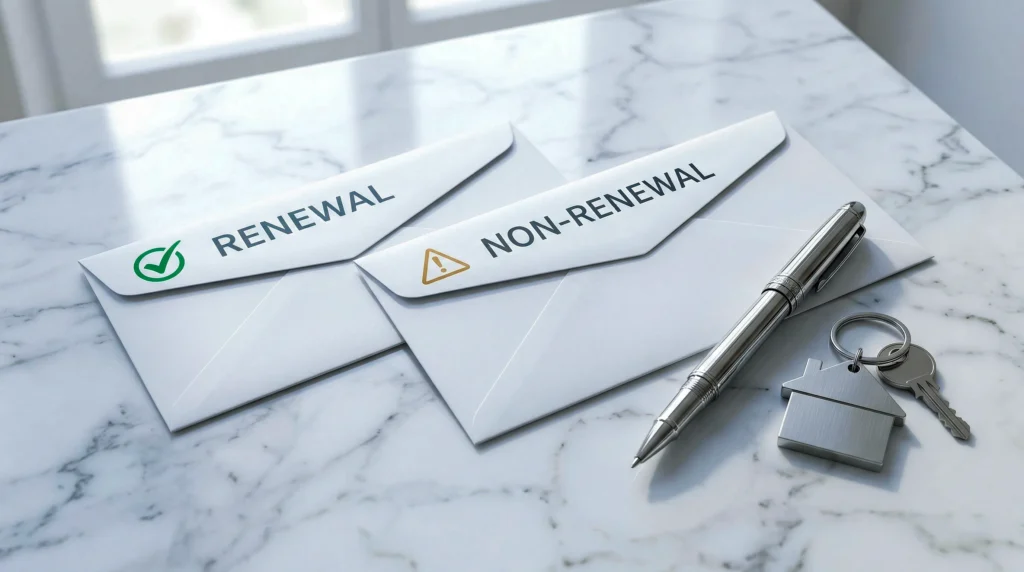
The primary difference is that an automatic renewal is a continuation of your contract under new or existing terms, while a non-renewal is a formal decision by the insurance company to end the relationship once your current policy term expires.
I see a lot of panic when homeowners receive a notice in the mail that looks different from their usual renewal packet. It is important to realize that a non-renewal is not the same as a cancellation. A cancellation happens in the middle of a policy term, often for non-payment or a major risk change, whereas a non-renewal is simply the carrier choosing not to sign up for another year.
In the 2026 insurance landscape, non-renewals are becoming a standard part of the “Hard Market.” I’ve policed numerous cases in states like Florida, California, and Texas where carriers are non-renewing entire zip codes because they want to reduce their total exposure to wildfires or hurricanes.
If you receive a non-renewal notice, it doesn’t necessarily mean you did anything wrong or that your home is uninsurable. It often means the insurance company’s internal risk math has shifted, and they are no longer the right fit for your geography.
According to Amy Bach, Executive Director of United Policyholders, the “Notice Period” is your most valuable legal protection during a non-renewal. Most states require carriers to provide you with a written notice at least 30 to 60 days before your policy ends.
This window is designed to give you enough time to follow a roadmap like my How to Change Homeowners Insurance Master Guide and find a replacement carrier.
I want to clarify another technical point: a non-renewal does not usually go on your permanent record as a black mark, as a cancellation for non-payment would. When you apply for a new policy, the new underwriter will ask if you have ever been non-renewed.
As long as the reason was the carrier’s withdrawal from the market or a change in their risk appetite, it shouldn’t significantly hurt your ability to get a new quote. However, if the non-renewal was due to your home having an old roof or a history of too many claims, that is a different story. In those cases, the Insurance Cop recommends fixing the underlying issue before you start shopping.
Understanding the difference between these two paths helps you stay calm and move quickly. If your policy is set for automatic renewal, your job is to police the price. If you receive a non-renewal, your job is to find a new shield. Either way, you have the right to change homeowners insurance at any time, so you are never truly stuck.
How do you stop an automatic homeowners insurance renewal?
If you have decided to follow my master guide to changing carriers, you need to know how to stop the automatic insurance renewal process before it triggers a payment from your bank. I have policed many situations where a homeowner found a better deal but waited too long to act, resulting in their mortgage lender paying the old, expensive bill.
To stop the cycle, you generally need to provide your current carrier with a written notice of non-renewal or a formal cancellation request at least 15 to 30 days before the expiration date listed on your declarations page.
The most effective way to halt the autopilot is to present your current company with a policy binder from your new insurer. I call this the definitive proof of coverage. When you tell your agent that you are not renewing, they may try to save the account by offering a small discount, but if you have already policed the math and found a better value elsewhere, you should stay firm.
According to guidelines from the Consumer Financial Protection Bureau, you have the right to choose your provider, and the bank must honor your request as long as the new policy meets their minimum standards. I recommend that you send your cancellation notice via email so you have a digital time-stamp of your request. This prevents the carrier from claiming they never received your notice and automatically charging your escrow account.
If your insurance is paid through escrow, stopping the renewal also requires a quick message to your mortgage servicer. You should upload your new insurance binder to your lender’s portal the same day you notify your old carrier. This ensures the bank’s insurance department redirects the funds to the correct company.
If you are worried about the timing, you can refer to my specific briefing on how to change homeowners insurance with escrow to see how major lenders like Chase or Wells Fargo handle these mid-cycle stops. The goal is to prevent the bank from sending a large check to a company you are trying to fire.
I also want to remind you that simply stopping your payments is not the correct way to end an automatic renewal. I red-flag this behavior because it can lead to a cancellation for non-payment, which is a major hit to your insurance score. Instead, use the formal process of signing a cancellation document.
By being proactive and following the proper administrative steps, you ensure that your policy ends exactly at 12:01 AM on your chosen date, allowing your new, more accurate protection to take over. This is how you enforce your rights as a consumer and keep your hard-earned savings in your own pocket rather than letting them flow into an unwanted renewal.
How to find your homeowners insurance information or search by address

I am often asked how to find my homeowners insurance information by homeowners who have let their policy sit on autopilot for so long they have actually forgotten which carrier they are with. This happens more than you would think, especially when a mortgage has been sold to a new servicer or after a busy move.
If you have lost your physical policy binder, your first police move should be to check your most recent mortgage statement. Since nearly every US lender requires insurance, they will list the name of your carrier and your policy number right there in the escrow or insurance section of your monthly bill.
If you are a buyer or an heir trying to figure out how to find out homeowners insurance by address, the process is a bit more investigative. Because of privacy laws, you cannot simply type an address into a public website and see someone’s private insurance contract.
However, I have found that you can often verify the existence of a policy by contacting the county tax assessor’s office if the property is in a region where taxes and insurance are bundled into a public assistance program. For most people, the most reliable address-based search is to request a Comprehensive Loss Underwriting Exchange report, also known as a C.L.U.E. report.
I spend a lot of time analyzing data from LexisNexis, the entity that manages the C.L.U.E. database. This report is like a credit report for your house. It lists every insurance claim filed at that specific address for the last seven years and the names of the carriers that provided the coverage.
If you are an owner, you are legally entitled to one free copy of this report every year. Reading this document is a great way to verify your history and ensure that the math your carrier is using for your automatic renewal is based on accurate data.
Ultimately, keeping a digital folder with your current declarations page is the best way to avoid having to search for this data in a crisis. I recommend that you download a PDF of your policy every time it automatically renews and save it with a file name that includes the year and the carrier.
This creates a clear paper trail that is essential if you ever need to document your continuous coverage history for a new underwriter. Whether you are finding an old policy or searching for details on a new purchase, being the person in the room with the most documentation is the only way to ensure the insurance industry treats you fairly.
Letting a policy sit on autopilot for years is the easiest way to lose track of which company actually holds your shield. If you’ve forgotten your carrier’s name entirely, you can use my steps for how to find my homeowners insurance to reclaim your records and stop a silent rate hike.
How long to keep homeowner insurance policies and why it matters
I advise you to keep your homeowners insurance policy documents for at least seven years, even after you have switched carriers or the policy has expired. While it might seem like useless paperwork once a new automatic renewal takes over, old policies are your only financial protection against latent damage claims.
These are issues like slow-leaking pipes behind a wall or structural cracks that may have originated years ago while a previous policy was still active. In the legal world of property insurance, the policy that was in force on the day the damage began is usually the one that has to pay for the repairs.
I spend a lot of time at Guide to Home Insurance policing the risks of discarded records. If you get sued in 2026 for a slip-and-fall injury that technically happened on your icy driveway in 2024, you need the 2024 policy to cover your legal defense.
Without that specific paperwork, you would have to pay for a lawyer out of your own pocket. I’ve policed numerous cases where homeowners lost thousands of dollars in coverage simply because they shredded their old declarations pages the moment their new automatic renewal arrived in the mail.
According to Robert Hunter, a former insurance commissioner and director of insurance for the Consumer Federation of America, maintaining a clear paper trail is the best way to hold carriers accountable for long-term obligations. He often notes that insurance is one of the few products where you might need the receipt years after the purchase is over.
I recommend that you scan every renewal notice and declarations page into a secure, encrypted cloud drive. Organizing these files by year and carrier name creates a digital archive that is immune to fire or flood damage.
You should also keep these records for tax purposes. If you use a home office or own a rental property, the Internal Revenue Service (IRS) can audit your records for up to seven years. They will want to see the exact premium math from your old policies to verify your deductions. If your policy automatically renewed with a higher premium, having the year-over-year comparison proves the legitimacy of your increasing expenses.
The bottom line is that your old policies are evidence of your continuous coverage. When you eventually decide to change homeowners insurance at any time, a new carrier will look at your history to decide your rate.
Being able to prove you’ve had no gaps for the last seven years is a major lever for getting a lower premium. By policing your own archives, you ensure that your past protection continues to provide value for your future financial stability.
How to sell homeowners insurance effectively

To sell homeowners insurance professionally in the US, an individual must be licensed by their state and choose between being a captive agent who represents one company or an independent agent who can shop across multiple carriers.
I want you to understand the industry side of the desk because it explains the incentives behind your automatic renewal. When you know how the person on the other end of the phone gets paid, you can better police the advice they are giving you about your policy math.
In my research, I’ve found that the most successful agents in the 2026 market are the ones who act as advisors rather than just salespeople. Captive agents (like those at State Farm or Allstate) are experts in their specific company’s products, but they are limited by their carrier’s Risk Appetite.
If their company takes a massive rate hike, they don’t have many options to help you. Independent agents, however, have a Duty to Shop. According to the National Association of Professional Insurance Agents (PIA), independent agents now handle a growing share of the market because they can pivot your coverage to a new carrier the moment an automatic renewal becomes too expensive.
I spent time analyzing the commission structures of the industry, and it is important to know that agents usually get a Renewal Commission every year your policy stays active. This is why some agents might not proactively tell you to switch carriers, they want that recurring income.
However, a truly professional agent will recognize when a loyalty penalty is hitting you and will offer to re-shop your policy. I always suggest that you ask your agent directly: Are you an independent or a captive agent? This simple question tells you if they have the tools to help you escape a bad renewal cycle.
If you are interested in entering the field yourself, you have to be prepared for the technical side of the 2026 hard market. Selling insurance today requires a deep understanding of replacement cost calculator math and the ability to explain complex coverage gaps to frustrated homeowners.
I’ve policed the data on agent performance, and the ones who win are those who emphasize transparency. They are the ones who help homeowners navigate the how to change homeowners insurance with escrow process without a single administrative error.
Ultimately, whether you are the buyer or the seller, knowledge is the only currency that matters. By understanding the professional standards of the industry, you can ensure your agent is working for your protection, not just their commission.
If you feel like your agent is being too passive during your renewal window, it might be time to take the wheel and follow my Master Guide to Changing Homeowners Insurance to find a professional who values your budget as much as you do.
The GTHI Switching Scorecard: Is your renewal worth the price?
Before you allow your policy to stay on autopilot, I want you to run your new renewal notice through the GTHI Switching Scorecard. This is a proprietary tool I built to help you decide if the convenience of an automatic renewal is worth the actual cost. I see too many people stay with a carrier because of a $100 “Loyalty Discount” while ignoring a $500 premium increase. Use this 5-point matrix to police your renewal like a pro.
| Factor | Green Flag (Stay) | Red Flag (Shop) |
| Premium Hike | Increase is less than 5%. | Increase is 10% or higher. |
| Coverage A | Matches current 2026 rebuild math. | Limit is the same as last year. |
| Deductible | Remains at a flat dollar amount. | Switched to a 2% or 5% percentage. |
| AM Best Rating | Carrier remains A or higher. | Rating has dropped to B or below. |
| Endorsements | Essential riders (Sewer/Mold) included. | Coverage has been stripped away. |
If your renewal triggers two or more Red Flags, you are officially paying a loyalty penalty. In the 2026 market, carriers are using the automatic renewal cycle to shift the risk onto you by increasing deductibles and lowering rebuild estimates.
If your “Coverage A” hasn’t moved but your price has, use my Replacement Cost Calculator to see the real gap. If you score low on this matrix, it is your cue to exit the autopilot trap and find a carrier that actually earns your premium.
Frequently Asked Questions: Tactical Answers for Homeowners
Navigating the 12-month policy cycle can raise a lot of technical questions, especially when the bank and the insurer are communicating behind your back. I have gathered five of the most common queries I see regarding the renewal process to give you the clarity you need.
Yes, but they cannot do it without a valid legal reason. While the automatic renewal clause implies a continuing relationship, the carrier can still cancel you for things like non-payment, discovering that you lied on your application, or if your home’s risk profile changes significantly (like an old roof failing an inspection). They are legally required to give you a 30-day notice before they cut the cord.
This is exactly how an escrow shortage happens. If your policy automatically renews at a higher price, your lender will pay the bill anyway to protect the house. However, they will then perform an escrow analysis and realize they didn’t collect enough from you. Your monthly mortgage payment will then jump, often by quite a lot, to pay back the shortage and cover the higher premium for next year.
Honestly, probably not. While carriers advertise “Loyalty Discounts,” the data I’ve policed shows that long-term customers often pay more than brand-new ones. This is because carriers assume you won’t leave. The best way to get a lower rate is to regularly shop around, even if you eventually decide to stay. Showing your current carrier a lower quote from a competitor is often the only way to get them to lower your “Loyalty Penalty” price.
Yes, you can stop it right up until the day the policy officially expires. Even if the lender has already sent the check, the insurance carrier is legally required to return that money if you provide a formal notice of non-renewal. You should also check my guide on when to cancel homeowners insurance when selling a house if your renewal is happening right around your closing date to avoid a double-payment mess.
Even if the lender has already sent the check, the insurance carrier is legally required to return that money if you provide a formal notice of non-renewal. I have policed this specific math in my guide on do you get a refund if you cancel homeowners insurance so you know exactly what to expect in your mailbox and how to calculate your unearned premium.
You have to watch your mail. Carriers are required by state law to send a non-renewal notice at least 30 to 60 days before your policy ends. In 2026, these are often sent via email as well. If you see a letter from your insurer that isn’t your usual bill, open it immediately. This window is your only time to find a replacement before your mortgage lender steps in and force-places a policy on you.
Conclusion: Taking Your Policy Off Autopilot
The primary takeaway is that while automatic renewal is a useful safety net, you should never let it be the final word on your property protection. In a market as volatile as 2026, the cost of being passive is simply too high.
By following the strategies I’ve outlined, auditing your renewal notice 60 days early, checking your rebuild math, and using the GTHI scorecard, you transition from a customer to a manager. You ensure that your family’s most valuable asset is protected by the best possible contract at the most competitive price.
As the Insurance Cop, my final directive is this: Respect the 12:01 AM clock, but don’t fear the switch. The industry counts on your hesitation to keep its profit margins high. Break the cycle, question the silent rate hikes, and always remember that you have the legal right to fire your carrier whenever the math no longer serves your interests. Your home deserves an active advocate, and today, that advocate is you.
[NEXT STEP] Run the Math Before Your Policy Renews
Don’t let your carrier decide what your home is worth in 2026. Many automatic renewals are based on outdated construction data that could leave you underinsured if a disaster strikes.
Before you let your policy auto-renew, use my Free Replacement Cost Calculator Toolkit. Get the local, zip-code-specific math for your:
- Total Rebuild Value for your 2026 home
- Actual Roof and Window Replacement Costs
- HVAC and Modern System Valuations