

When you sign a home insurance contract, you aren’t just buying a piece of paper; you are investing in a financial safety net for your most valuable asset. However, the strength of that safety net depends entirely on your ability to understand the language within it. According to the National Association of Insurance Commissioners (NAIC), understanding the nuances of your policy is the single best way to avoid financial gaps when a disaster strikes.
Many homeowners find themselves underinsured or facing denied claims simply because they misinterpreted a single word or phrase in their policy documents. This home insurance glossary was created to bridge the gap between complex industry terminology and the practical knowledge you need as a policyholder. By mastering these terms, you empower yourself to communicate more effectively with insurance agents, understand the true value of your “Replacement Cost Value,” and navigate the differences between common risks as outlined by the Insurance Information Institute (III).
In the sections below, we have organized the most critical concepts into easy-to-navigate categories, followed by a full A-Z reference list. Whether you are looking for a quick definition of a “Deductible” or a deep dive into “Subrogation,” this guide ensures you are never caught off guard by the fine print of your homeowners insurance policy.
Core Home Insurance Concepts (Quick Links)
Before diving into our full A-Z reference, it is helpful to master the foundational concepts that appear in almost every policy conversation. If you understand these seven home insurance glossary of terms, you will have a much clearer picture of how your protection works and what your out-of-pocket costs might be.
The amount you agree to pay out-of-pocket toward a claim before your insurance provider steps in to cover the remaining costs. Generally, a higher deductible leads to a lower premium.
An insurance term for a specific risk or cause of loss covered by your policy, such as fire, windstorm, or theft. It is vital to know which perils are “named” in your policy and which are excluded.
This protects you financially if someone is injured on your property or if you accidentally damage someone else’s property. It covers legal fees and medical expenses up to your policy limit.
Replacement Cost Value ( RCV)
A method of valuation that pays the cost to replace or repair your damaged property with materials of similar kind and quality, without deducting for wear and tear (depreciation).
Actual Cash Value (ACV)
Unlike replacement cost, ACV pays the value of the item at the time of the loss, which means depreciation is subtracted from the payout.
Policy Limit
The maximum amount your insurance company will pay for a covered loss. If a major disaster occurs, any costs exceeding this limit are the responsibility of the homeowner.
Policy Basics & Documents
Understanding the administrative side of your coverage is the first step in mastering your home owners insurance glossary. When you receive your policy package, it contains several key documents that outline exactly what you are paying for and the legal timeline of your protection.
- Declarations Page (Dec Page): Often considered the most important part of your policy, the “Dec Page” is a summary of your coverage. It lists the named insured, the property address, policy limits, deductibles, and the premium amount. It is the first page you should check to verify your coverage details.
- Binder: A temporary insurance contract that provides proof of coverage until the formal policy is issued. Binders are frequently required by mortgage lenders during the home-buying process to ensure the asset is protected before the closing date.
- Endorsement (or Rider): An amendment or addition to your existing policy that changes the terms of the original contract. For example, you might add a “scheduled personal property endorsement” to provide extra protection for high-value items like jewelry or fine art.
- Named Insured: The person (or persons) specifically designated by name in the policy documents as being protected. In most cases, this includes the homeowner and their spouse, but it can also include other residents depending on the policy language.
- Effective Date & Expiration Date: These represent the exact window of time your policy is active. If a loss occurs even one day after the expiration date without a renewal, you will not be covered.
- Exclusion: A specific transition, item, or peril that your policy explicitly states it will not cover. Common exclusions in a standard home insurance glossary include damage from floods, earthquakes, or intentional acts.
- Grace Period: The set amount of time after a premium payment is due during which the policy remains in force. If you miss this window, your policy may “lapse,” leaving you without protection.

According to the Consumer Financial Protection Bureau (CFPB), reviewing these documents annually is a best practice to ensure your coverage keeps pace with rising construction costs and home value appreciation.
Types of Coverage & Protection
When reviewing a home insurance glossary of terms, it is important to realize that a standard policy is actually a bundle of several different types of protection. These are often categorized by letters (Coverage A through F) in your policy documents. Understanding these distinctions ensures you have enough “rebuilding” power for your structure and enough “replacement” power for your belongings.
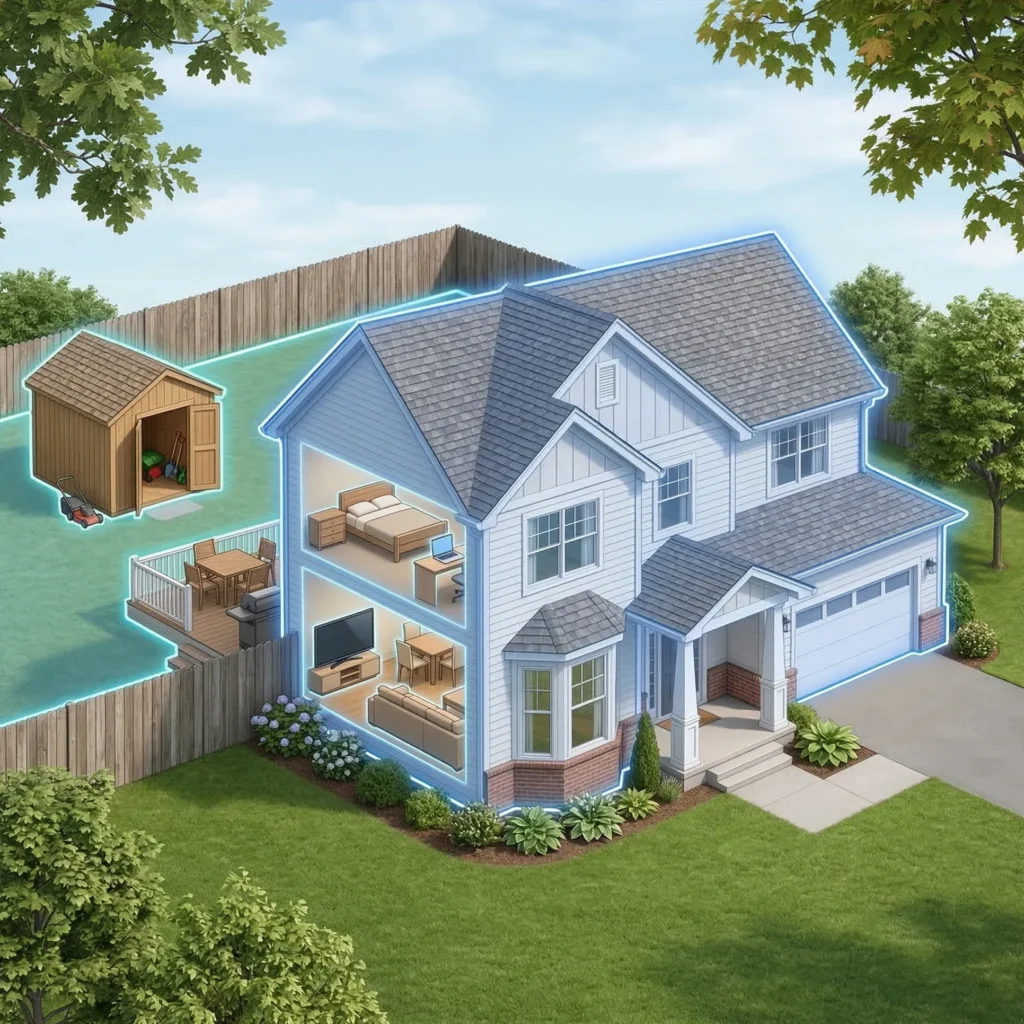
- Dwelling Coverage (Coverage A): This protects the physical structure of your home, including the walls, roof, and foundation. If a fire or windstorm damages your house, Dwelling Coverage pays to repair or rebuild it.
- Other Structures (Coverage B): This covers buildings on your property that are not attached to your main house. This includes detached garages, tool sheds, gazebos, and fences. Typically, this limit is set at 10% of your Dwelling Coverage.
- Personal Property (Coverage C): This covers your “stuff”: furniture, electronics, clothing, and appliances, even if they are damaged or stolen while you are away from home. Most experts recommend creating a home inventory (as suggested by Ready.gov) to ensure this limit is high enough to replace everything you own.
- Loss of Use / Additional Living Expenses (ALE) (Coverage D): If a covered peril makes your home uninhabitable, Coverage D pays for the extra costs of living elsewhere. This includes hotel bills, restaurant meals, and even storage fees while your home is being repaired.
- Personal Liability (Coverage E): This provides financial protection if a guest is injured on your property and sues you, or if you accidentally cause damage to someone else’s property. It covers both the settlement costs and your legal defense fees.
- Medical Payments to Others (Coverage F): Often called “no-fault” coverage, this pays for small medical bills (usually up to $5,000) if a guest is injured on your property, regardless of who was at fault. It is designed to settle small issues quickly before they turn into major lawsuits.
- Ordinance or Law Coverage: An often-overlooked home insurance glossary term, this covers the increased cost of rebuilding your home to comply with the latest local building codes, which may have changed since your house was originally built.
- Scheduled Personal Property: For high-value items like engagement rings or fine art, a standard policy may have “sub-limits” (e.g., only $1,500 for jewelry). Scheduling these items provides them with their own specific, higher level of protection.
The Claims and Settlement Process
When the “worst-case scenario” happens, the abstract language of your policy becomes a financial reality. Navigating the aftermath of a loss requires a firm grasp of the home insurance glossary of terms used during the claims cycle. Knowing the difference between what you think you are owed and what the contract states you are owed is the key to a successful recovery.
A formal request made by the policyholder to the insurance company for payment or repair based on the terms of the insurance policy.
Proof of Loss
A formal, notarized document provided by the insured to the insurance company that details the amount of money being requested and provides evidence of the damage.
The decrease in the value of an item or structure over time due to age, wear and tear, or obsolescence. This is a critical factor in “Actual Cash Value” settlements.
The process by which an insurance company, after paying a loss to its insured, pursues the “third party” that actually caused the loss to recover the money paid out.
Appraisal
A process used when the homeowner and the insurance company disagree on the amount of the loss. Both sides hire an independent appraiser to determine the fair value of the claim.
The person or entity (often your mortgage lender) named in the policy who has a legal interest in the property and is entitled to receive the claim check along with you.
According to the National Association of Insurance Commissioners (NAIC), keeping a detailed record of all communication with your adjuster is one of the most effective ways to ensure your claim stays on track.
In the world of property protection, not all damages are created equal. This part of our home owners insurance glossary focuses on the specific events that trigger your coverage and the specific situations that do not. If you are looking to compare different policy types, such as an HO3 vs HO5, understanding these home insurance glossary terms is the only way to know the true extent of your protection.
The actual cause of a loss. Common perils include fire, lightning, windstorm, hail, and theft. Your policy will explicitly state which perils it covers.
Hazard
A condition that increases the likelihood of a loss or the severity of a loss. For example, a pile of oily rags in a garage is a “fire hazard,” and a dead tree leaning over a roof is a “physical hazard.”
A type of policy that covers only the specific causes of loss listed in the document. If a peril is not named (e.g., “Weight of Ice and Snow”), it is not covered.
This is the gold standard of coverage. An open-perils policy covers any cause of loss unless it is specifically excluded in the policy language. This offers much broader protection than a named-perils policy.
Exclusions
These are the “No” zones of your policy. Standard homeowners insurance almost never covers damage from floods, earthquakes, or normal “wear and tear.” For these risks, you often need separate policies or specific endorsements.
Proximate Cause
A legal term in a glossary of home insurance terms referring to the initial event in a chain of events that leads to a loss. If a windstorm knocks a tree onto your house, the damage is covered because wind is a covered peril.
Moral Hazard
A term used by underwriters to describe a situation where a policyholder might be less careful because they know they have insurance, or worse, might intentionally cause a loss to collect a payout.
Catastrophe
In insurance terms, this is a single incident (like a hurricane or wildfire) that causes a massive amount of damage across many properties simultaneously, often triggering special “Catastrophe Deductibles.”
ccording to the Federal Emergency Management Agency (FEMA), many homeowners mistakenly believe their standard policy covers flood damage. In reality, flood insurance must almost always be purchased separately through the National Flood Insurance Program (NFIP).
We recommend bookmarking this home insurance glossary as a reference tool for whenever you review your annual policy renewals.
- Actual Cash Value
- Additional Living Expenses
- Adjuster
- Agentic AI
- Agreed Value
- Algorithm
- Assignment of Benefits (AOB)
- Binder
- Carrier
- Claim
- Claim Denial
- Climate events
- Code Upgrades
- Coinsurance Penalty
- Concierge
- Coverage
- Coverage A
- Declarations Page
- Deductible
- Denied
- Depreciated value
- Depreciation
- DOI
- Drone Inspection Clause
- Duty to Mitigate
- Dwelling Coverage
- Endorsement
- Exclusion
- Extension
- Force-Placed
- Forensic Appraiser
- Full Engineering Report
- Guest Medical Coverage
- HO-3
- Indemnification
- Insurance Business
- Insurtech
- Lapse in Coverage
- Liability Coverage
- Loss of Use
- Loss Payee
- Matching Laws
- Mitigate
- Mortgagee Clause
- Named Peril
- NFIP
- Non-Renewal
- Open Peril
- Other Structure
- Peril
- Personal Property
- Policy Binding
- Post-inflation
- Precision Underwriting
- Premium
- Premium Restoration Networks
- Pro-Rata Cancellation
- Regulatory Transparency Complaint
- Reinsurance
- Replacement Cost Value
- Residential Valuation
- RESPA
- Restorer
- Risk Anomalies
- Risk Concentration
- Roof Integrity
- Secondary Peril
- Short-Rate Cancellation
- Smart-Settlement
- Solvency
- Split Deductible
- State Guaranty Fund
- Subrogation
- Substantive Human Review
- Supplement
- Surplus Lines
- Underwriting
- Unearned Premium
Is there a technical term missing from our home insurance glossary? Let us know, and we will add it to our next update.
Frequently Asked Questions (FAQ)
Navigating a home insurance glossary can be complex, and many policyholders have similar questions when trying to decode their coverage. Below are detailed answers to the most common inquiries regarding home insurance glossary terms and how they impact your financial protection.
Understanding the specific language in a home owners insurance glossary is the only way to ensure you aren’t leaving your most valuable asset vulnerable. Many homeowners assume that “full coverage” means everything is protected under any circumstance. However, insurance is a legal contract defined by very specific terminology. If you don’t understand the difference between a “Deductible” and an “Exclusion,” or “Replacement Cost” versus “Actual Cash Value,” you may find yourself facing a massive financial gap after a disaster.
According to the Insurance Information Institute, being underinsured is a common problem in the U.S., often stemming from a misunderstanding of policy limits and definitions. By mastering this glossary of home insurance terms, you can ask your agent the right questions, accurately compare quotes from different companies, and ensure that your “Declarations Page” truly reflects the level of protection your family needs.
This is perhaps the most important distinction in any home insurance glossary. Actual Cash Value (ACV) pays you the value of your property at the time of the loss, which means the insurance company subtracts “depreciation” (wear and tear) from your payout. For example, if a 10-year-old roof is destroyed, an ACV policy only pays what a 10-year-old roof is worth today, not what it costs to buy a new one.
Conversely, Replacement Cost Value (RCV) pays the actual cost to repair or replace the damaged property with new materials of similar quality, without any deduction for depreciation. While RCV policies typically come with a higher premium, they provide much better financial security. Without RCV, a major claim could leave you responsible for thousands of dollars in “out-of-pocket” costs to cover the difference between the depreciated value and the price of new construction.
While these words are often used interchangeably in everyday conversation, they have distinct meanings in the insurance world. A Peril is the specific cause of a loss. It is the “event” that triggers the claim, such as fire, lightning, windstorm, or theft. Your policy is essentially a list of which perils are covered and which are not.
A Hazard, on the other hand, is a condition or situation that increases the probability or the severity of a loss from a peril. For example, a pile of dry brush near your home is a “physical hazard” because it increases the likelihood of a fire (the peril). Similarly, leaving your front door unlocked is a “moral hazard” because it increases the chance of theft. Understanding this distinction is vital because insurance companies use “hazard assessments” during the underwriting process to determine your premium and your eligibility for coverage.
When browsing a home insurance glossary, you will encounter two main types of policy structures: Named Perils and Open Perils. A Named Peril policy (often an HO-2) only covers the specific risks explicitly listed in the policy. If a risk isn’t on the list, such as a specific type of water damage, it is not covered. In this scenario, the “burden of proof” is on the homeowner to show that the damage was caused by a listed peril.
An Open Peril policy (often an HO-3 or HO-5) is much broader. It covers every possible cause of loss unless it is specifically excluded in the policy language. This is generally the preferred choice for most homeowners because it offers a wider safety net. In an Open Perils claim, the “burden of proof” shifts to the insurance company; they must prove that an exclusion applies in order to deny the claim.
Yes, and this is where the home insurance glossary term “Endorsement” (also known as a “Rider”) comes into play. An insurance policy is not a static document; it can be amended to fit your changing needs. If you buy an expensive engagement ring, start a home-based business, or install a new swimming pool, your standard policy may not provide enough coverage.
By adding an Endorsement, you are essentially “plugging the gaps” in your standard protection. Common endorsements include “Sewer Backup Coverage,” “Scheduled Personal Property” for high-value items, or “Identity Theft Protection.” According to Investopedia, using endorsements is an efficient way to customize your coverage without having to purchase an entirely new policy. It allows you to tailor your home owners insurance glossary definitions to your specific lifestyle and assets.
More Home Insurance Resources
Mastering our home insurance glossary is the first step toward becoming a confident policyholder. However, understanding the terms is most effective when applied to real-world scenarios, from choosing the right provider to navigating the stress of a property loss.
Property Insurance Claims: A Step-by-Step Guide to Successful Recovery
If you are currently facing a loss, our step-by-step checklists will guide you through the process. We use the home owners insurance glossary terms you’ve learned here to ensure you provide the right documentation and maximize your settlement.