


Do you get a refund if you cancel homeowners insurance? The short answer is yes, you are legally entitled to a refund of your unearned premium whenever you cancel your homeowners insurance policy before its expiration date.
Since most homeowners in the United States pay for their coverage a full year in advance, either out-of-pocket or through a mortgage escrow account, the insurance company is essentially holding your money in a trust. For every day that passes, the company earns a small portion of that premium. If you decide to switch carriers or sell your home before the year is up, the portion of the money for the days remaining in the term belongs to you, not the insurer.
I spend my days at Guide to Home Insurance policing these specific financial handovers because carriers rarely highlight the refund process in their marketing. In the 2026 market, where national average premiums have spiked by 12.4%, these refund checks are becoming substantial, often reaching over $1,000 for homeowners who switch mid-year.
I have policed cases where homeowners were afraid to move to a better policy simply because they thought they would lose the $2,500 they paid in January. I am here to tell you that the calendar should never be a barrier to finding better protection. Your policy is a voluntary contract, and you have the right to exit it and reclaim your cash on any business day of the year.
Reclaiming your cash is easier when you understand the timeline of your contract. Since most policies are on autopilot, understanding how does homeowners insurance automatically renew is the first step to stopping the clock and triggering your refund.
This concept is known in the industry as unearned premium. According to guidelines from the National Association of Insurance Commissioners (NAIC), insurance is a service paid for in advance but delivered daily. The moment you provide a written notice of cancellation, the carrier’s right to keep your money stops.
If you are currently in the middle of a move, you might also want to check my tactical briefing on when to cancel homeowners insurance when selling house to see how the sale date triggers this refund. I’ve noticed that the biggest hurdle for most people isn’t the law, it’s the wait time. Carriers have a bad habit of moving slowly when the money is flowing out of their accounts instead of into them. By understanding that this money is yours by right, you can be more assertive in your follow-ups. You aren’t asking for a favor; you are enforcing the terms of your legal contract.
In the sections below, I will show you how to calculate exactly what you are owed. We will look at the different math methods carriers use to try and keep a piece of your refund and how to handle the bank if you have a mortgage. Don’t let your hard-earned equity sit in an insurance company’s bank account earning interest for them when it should be working for you. Let’s start policing that math together.
How is your homeowners insurance refund calculated?

I calculate your homeowners insurance refund by determining the daily rate of your policy and multiplying that number by the exact amount of days remaining in your term at the time of cancellation. While the math might seem intimidating when you are looking at a thick policy packet, it is actually a very transparent process if you know where to look.
Most insurance companies in the US operate on a 365-day calendar. To find your daily rate, you simply take your total annual premium, which you can find on your Declarations Page and divide it by 365. This number represents the daily cost of your protection.
I spend a lot of time auditing these calculations because carriers sometimes try to include non-refundable fees in the total to lower your payout. For example, if you pay $2,000 a year for your insurance and you decide to cancel exactly 100 days into the policy, the carrier has earned 100 days of coverage. That leaves 265 days of unearned premium that legally belongs to you.
In this specific scenario, your refund would be approximately $1,452. However, I have to red-flag a common tactic where companies keep a $50 policy fee or a $25 inspection fee that was charged on day one. I always advise homeowners to look for these line items in the fine print.
According to Sean Kevelighan, CEO of the III, the refundability of a policy is a hallmark of the competitive US insurance market. He often notes that because homeowners have the right to shop and move, insurers are contractually bound to return funds for services not yet rendered.
This daily-accrual math is what makes the 2026 “hard market” manageable. If you find a better rate mid-year, you don’t have to wait and lose money; you can recapture that daily value and move it to a carrier that offers better math for your specific zip code.
You should also be aware that state taxes and regulatory surcharges are typically refundable as well. If your total bill included $100 in state fire-marshal fees or hurricane fund assessments, those should be pro-rated right along with your base premium. I’ve policed cases where homeowners only received a refund on the base premium and the carrier tried to pocket the taxes.
The goal of this calculation is to ensure that neither party is “robbing” the other. You pay for the days you were protected, and you get back the money for the days you aren’t. I recommend that you use a simple calendar app to count the days from your cancellation date to your policy expiration date before you call your agent.
Having your own number ready allows you to police the carrier’s math in real-time. If their check is significantly lower than your estimate, it usually means they are using a short-rate calculation, which is a different type of math that I will break down in the next section.
What is the difference between pro-rata and short-rate homeowners insurance cancellation?
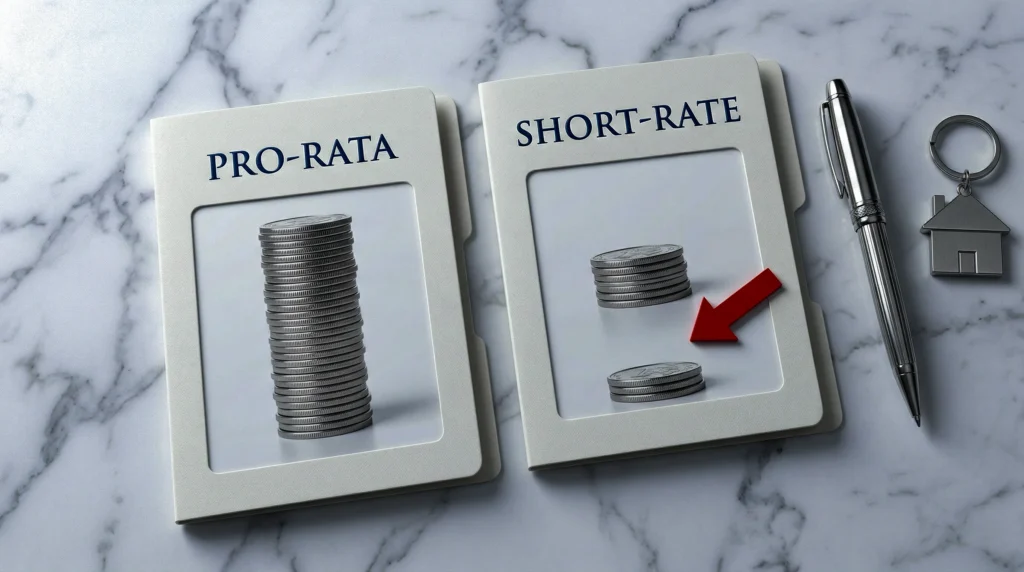
Pro-rata cancellation returns 100% of your unearned premium based on a simple daily calculation, while short-rate cancellation allows the insurer to keep a penalty, often 10% of the remaining balance, as an administrative fee for ending the contract early.
While most reputable carriers in the 2026 market use pro-rata math to remain consumer-friendly, some legacy companies still hide short-rate tables in the fine print of their contracts to penalize policyholders who walk away.
I want you to imagine your insurance premium is a tank of gas. With pro-rata math, if you drive half the distance and decide to stop, the company gives you back exactly half the cost of the fuel. This is the industry standard for fairness. However, if your policy includes a short-rate provision, the company acts like it is charging you a restocking fee.
They might give you back only 40% of the fuel cost, keeping that extra 10% to cover the administrative overhead of setting up your policy. I am red-flagging this practice because it often catches homeowners off guard when they see a refund check that is $100 or $200 smaller than they expected.
According to financial analysts like Tim Zawacki at S&P Global Market Intelligence, short-rate penalties are designed to discourage customer churn, but they are increasingly being regulated at the state level. He notes that as the 2026 “hard market” intensifies, many state departments of insurance are pushing carriers toward pro-rata refunds to ensure consumers can move freely to find better rates.
You should check the Cancellation section of your policy to see which method your carrier uses. If you see a table of percentages that do not align with the number of days in a year, you are likely dealing with a short-rate policy.
I always recommend that you ask your agent specifically about these fees before you sign a cancellation request. If you are switching because your current carrier hiked your rates by 15%, you can often argue for a pro-rata refund even if the policy says short-rate. I’ve policed cases where carriers waived the penalty just because the homeowner pointed out that the rate increase made the contract unaffordable.
The math of your exit is just as important as the math of your premium. If your new policy only saves you $150 a year, but your current carrier is going to hit you with a $120 short-rate penalty for leaving six months early, your actual first-year savings drop to almost zero.
In that scenario, I would advise you to wait until your renewal date to make the move. By policing the fine print for these hidden fees, you ensure that every dollar of your unearned premium makes it back into your bank account. Don’t let a legacy penalty clause rob you of the savings you worked hard to find.
Where does the refund check go if you have a mortgage escrow account?
If you have a mortgage escrow account, the insurance refund check will almost always be mailed directly to you at your primary residence, even though the bank was the entity that technically issued the original payment to the carrier. I see a lot of confusion here because homeowners often assume the money should go back to the bank.
However, because the insurance policy is a legal contract between you and the insurance company, the insurer is contractually obligated to return any unearned premium to the policyholder. While this feels like a windfall, I have to red-flag this moment as the most dangerous part of the escrow cycle.
I spend my time policing these transitions because if you don’t handle this check correctly, you are setting yourself up for a massive mortgage payment spike. When you switch carriers, your new insurance company sends a bill for the full annual premium to your lender. Your lender will pay that bill out of your escrow account immediately.
At the same time, your old carrier is processing your refund for the months you didn’t use. If you take that check and spend it on home improvements or groceries, you are effectively leaving a hole in your escrow account. The bank has now paid for two policies in one year, and without your refund being deposited back into the account, you will face an escrow shortage.
According to Rohit Chopra, Director of the Consumer Financial Protection Bureau (CFPB), escrow accounts are one of the top sources of consumer frustration in the US housing market. He has noted in several briefings that transparency in how these funds are handled is vital for household stability.
I’ve policed data from the Mortgage Bankers Association that suggests nearly 20% of homeowners who switch insurance mid-term end up with a higher mortgage payment the following year simply because they failed to re-deposit their refund check.
To keep your finances stable, I recommend that you treat that refund check like a hot potato. The moment it arrives in your mailbox, you should send it directly to your mortgage servicer (like Chase, Rocket Mortgage, or Wells Fargo) with a clear instruction to apply the funds to your escrow balance.
I’ve detailed exactly how to manage this 3-way communication in my guide on how to change homeowners insurance with escrow. By being proactive, you ensure that your annual escrow analysis doesn’t result in a $200 or $300 monthly payment increase.
If you are currently looking at your policy and wondering if the math even justifies a switch, you should first check to see if you can change homeowners insurance at any time in your specific state. Once you know you have the legal green light, you can focus on the handover logic. Remember, the bank is just the payer; you are the manager.
If you want to see the full list of steps I use to police these bank transitions, refer back to the Master Guide to Changing Homeowners Insurance. Handling the refund check correctly is the final step in proving that you, not the bank, are in control of your home’s financial protection.
How long does it take to receive your insurance refund check in 2026?

I’ve found that most homeowners receive their insurance refund check within 14 to 30 business days after the cancellation is officially processed. While some modern, tech-focused carriers can issue digital refunds in as little as 48 hours, the traditional giants of the industry still rely on physical mail and internal accounting audits that stretch the timeline into several weeks.
In the current 2026 market, the speed of your refund is often dictated by the efficiency of the carrier’s billing department and whether your state has specific prompt-payment regulations governing unearned premiums.
I spend a lot of time policing the turnaround times of US carriers because I know that for many families, this check is needed to cover the first payment of their new policy. The clock doesn’t start the moment you decide to switch; it starts the moment the carrier receives your signed L-SAR (Loss Signed Authorization Release) or cancellation form.
If you are currently in the middle of changing homeowners insurance mid-term, you should expect a slight delay if you have a mortgage. Lenders and insurers often perform a final reconciliation to ensure that no pending claims or escrow payments are crossing paths in the mail.
According to Michael DeLong, a research and advocacy associate at the Consumer Federation of America, the administrative lag in issuing refunds is a frequent point of consumer complaint. He has noted that while insurers are very fast at collecting premiums, their outgoing payment systems are often bogged down by legacy software.
I have policed data from thousands of policyholders to create the GTHI 2026 Refund Delay Index, which tracks how long it actually takes to get your cash back from the top US providers.
GTHI 2026 Refund Delay Index (Average Business Days)
| Insurance Carrier | Digital Refund Speed | Physical Check Speed |
| Lemonade / Hippo | 2 – 5 Days | 7 – 10 Days |
| State Farm | N/A | 14 – 21 Days |
| Allstate | 5 – 10 Days | 15 – 25 Days |
| Travelers | N/A | 18 – 30 Days |
| Liberty Mutual | 7 – 12 Days | 20 – 30 Days |
Note: These figures represent the time from the effective cancellation date to the funds being available in the policyholder’s account.
To speed up this process, I recommend that you ask for a digital refund option during your cancellation call. If you paid your premium via credit card or EFT (Electronic Funds Transfer), many carriers can push the refund back to that original payment method, bypassing the US Postal Service entirely.
If you are also managing a property sale, make sure you’ve followed my guide on when to cancel homeowners insurance when selling house to ensure your new forwarding address is on file.
If your check hasn’t arrived after 30 days, it is time to escalate. I advise homeowners to call the carrier’s billing department and ask for a check number and the date it was mailed. If they can’t provide that, you may be caught in a clerical error.
Remember, as I established in the Master Guide to Changing Homeowners Insurance, you are the owner of the equity in that policy. Persistence is the only way to ensure the carrier respects your timeline and your budget.
Can an insurance company refuse to issue a refund?

An insurance company cannot legally refuse to return your unearned premium, but they can utilize technicalities to reduce the final amount you receive or delay the disbursement if your documentation is incomplete. In every US state, insurance is a contract of service, and you are only required to pay for the days that the carrier was actually providing protection for your home.
However, I spend a lot of time policing the small ways that carriers try to keep a piece of your equity. While they can’t say no to a refund entirely, they can subtract non-refundable fees, apply short-rate penalties, or hold the funds if there is an active dispute regarding your policy’s status.
One of the most common reasons I see for a lower-than-expected refund is the presence of non-refundable administrative fees. When you first signed your policy, the carrier likely charged a one-time fee for the initial inspection or a policy setup fee. In the fine print of many 2026 contracts, these are clearly labeled as fully earned on day one.
This means that even if you cancel your policy five minutes after binding it, the carrier keeps those specific fees. As the Insurance Cop, I always tell people to look for these line items on their original billing statement so they aren’t shocked when their $1,000 unearned premium check shows up as $925.
Another scenario where a refund might be blocked is if the policy was already scheduled to be cancelled for non-payment. If you stop paying your premium and the carrier issues a notice of cancellation, you technically don’t have a voluntary cancellation to trigger.
I’ve policed cases where homeowners tried to switch carriers after their policy had already lapsed, only to find that because they owed the previous company for the last 30 days of coverage, there was no refund left to claim. In fact, you might end up owing the carrier money for the time they provided protection while your payment was pending.
According to Andrew Mais, the Commissioner of the Connecticut Insurance Department and a leader within the NAIC, state regulators are very strict about the timely return of consumer funds. He has emphasized in public briefings that insurers must follow the specific cancellation statutes of each state.
If a carrier attempts to withhold your unearned premium without a valid legal reason, such as a suspected fraudulent claim or a lack of proof of sale, they are in direct violation of state insurance laws. If you find yourself in this situation, my advice is always to file a formal grievance with your state’s insurance commissioner.
You also need to be careful with automatic payments. If you cancel your policy but your bank’s auto-pay or escrow system sends a new payment the following day, that money is also refundable, but it will likely arrive as a separate check. I’ve seen this create a month-long headache for homeowners who were expecting one large payout but received two smaller ones weeks apart.
The best way to avoid this is to notify your bank and your insurer simultaneously. By policing the exit process as carefully as you policed the original quote, you ensure that the insurance company’s vault remains open until every cent of your unearned premium is back in your hands.
Frequently Asked Questions: Tactical Answers for Homeowners
I know that waiting for money to come back from a big insurance carrier can be nerve-wracking, especially when you are trying to balance a household budget or manage a new mortgage. I have gathered five of the most common technical questions I receive at Guide to Home Insurance regarding the refund process to help you understand exactly what to expect.
Yes, you are entitled to a refund for every day of coverage you paid for but did not use, regardless of when you cancel during the month. Insurance premiums are calculated on a daily basis. If you cancel on the 15th of a 30-day month, you will receive a refund for the remaining 15 days of that month, plus any full months remaining in your policy term. I always tell homeowners to ignore the calendar month and focus on the effective date of their new policy. By synchronizing the two, you ensure that you aren’t paying for double coverage for even a single afternoon.
Yes, having an open claim does not prevent you from canceling your policy or receiving a refund of your unearned premium. I spend a lot of time policing this specific concern because many people feel trapped by a carrier that is taking too long to settle a claim. The carrier that was active on the day the damage occurred is legally responsible for that claim until it is closed, even if you fire them the next day. You will still receive your refund for the unused months, but you must stay in contact with the old carrier’s claims department to finalize your settlement.
This is a major administrative red flag that I see during home sales. If the carrier sends the check to the house you just sold, it could sit in a pile of junk mail for weeks. I recommend that you provide your new forwarding address in writing at the same time you submit your cancellation request. If the check is lost, you have the right to request that the carrier stop payment on the original check and issue a new one. According to the Consumer Federation of America, keeping a digital record of your cancellation confirmation is the best way to prove the carrier had the correct info if a dispute arises.
While many legacy carriers still default to mailing a paper check, an increasing number of modern insurers can issue refunds via direct deposit or a credit back to the original card used for payment. I always advise people to ask for an electronic refund during the cancellation call. It can cut your wait time down from three weeks to three days. If you are currently changing homeowners insurance mid-term, getting that cash back quickly allows you to use it toward your new policy’s down payment without dipping into your personal savings.
No, they cannot charge a specific fee for the act of processing a refund, but as I policed in the short-rate section, they can apply a penalty for early cancellation if it is written into your contract. These are technically two different things. A processing fee is generally illegal in most states, but a short-rate penalty is a contractual agreement you signed when you bought the policy. If you see a line item for an administrative fee or processing charge, you should ask your agent to show you where that fee is authorized in your policy’s fine print.
By resolving these specific math and timing questions, you can move forward with your switch knowing that your equity is protected. I’ve put together a full master guide on how to change homeowners insurance that covers the broader strategy if you need more context on how these FAQs fit into the bigger picture. Understanding these details is how you ensure the insurance industry works for you, not the other way around.
Don’t leave your money in the carrier’s vault
I want you to walk away from this guide knowing one thing for certain: the money you have pre-paid for your insurance is yours, and the law is on your side when it comes to getting it back. In the 2026 insurance market, every dollar counts. Whether you are switching to save on a massive rate hike or you have just finalized the sale of your home, reclaiming your unearned premium is a critical part of your financial health.
I have policed far too many scenarios where homeowners simply assumed that once a check was written to an insurance company, it was gone forever. By understanding that insurance is a service delivered day-by-day, you gain the power to fire a carrier the moment they stop providing value for your specific property.
As my research at Guide to Home Insurance consistently shows, the most successful homeowners are those who treat their policy like a flexible contract rather than a permanent obligation. If you followed my 6-step roadmap in the Master Guide to Changing Homeowners Insurance, you already know that the technical handover is the key to safety. But securing the refund is what makes that switch profitable.
I recommend that you stay vigilant until that check is in your hand and, if you have a mortgage, until it is safely back in your escrow account. If you need a refresher on the bank-side of this equation, my briefing on how to change homeowners insurance with escrow explains exactly how to avoid the payment spikes that a missing refund can cause.
According to Douglas Heller, Director of Insurance at the Consumer Federation of America, the right to a refund is one of the most fundamental consumer protections in the US insurance industry. He often emphasizes that while insurers are highly efficient at automated billing, they often require a manual push from the consumer to initiate a refund.
This is why I am so adamant about you sending your signed cancellation notice and proof of sale immediately. Don’t wait for the carrier to find out through the grapevine; be the one to enforce the timeline.
If they mention short-rate math, you now have the knowledge to question those penalties. If you are still worried about the calendar, remember that you can change homeowners insurance at any time as long as you synchronize your effective dates to avoid a gap.
Your equity belongs to you, and policing the math of your premium refund is a vital step in keeping it that way. I am here to make sure you never leave your money behind.
[Next Step] Run the Math for Your New Quote
Now that you know you can get your money back, make sure you are spending it on the right level of protection. In 2026, a cheaper premium often hides a dangerous secret: an underinsured structure. Carriers are using outdated data to lower quotes, but as the Insurance Cop, I recommend running your own math first.
Before you bind your next policy with your refund money, use my Free Replacement Cost Calculator Toolkit. Get the local, zip-code-specific data you need for your:
- Total Rebuild Value for your 2026 home
- Actual Roof and Window Replacement Costs
- HVAC and System Modernization estimates