


A million-dollar question: Can you change homeowners insurance at any time? The short answer is yes: you can change your homeowners insurance at any time, on any day of the year, regardless of when your policy is set to renew. There is no federal or state law that requires you to stay with a carrier for the full 12-month term.
In the 2026 US insurance market, where national average premiums have risen by 12.4% according to S&P Global, the ability to move your coverage mid-term is your most powerful tool for defending your household budget.
I’m the Insurance Cop, and I spend my day policing the “fine print” that keeps homeowners in bad deals. Many people feel a misplaced sense of obligation to their current insurer, or they fear that their mortgage lender will block a mid-year move.
As we established in our Master Guide to Changing Homeowners Insurance, your policy is a voluntary contract. If you find a more accurate Replacement Cost Valuation or a lower premium tomorrow, you have the right to fire your carrier and get a refund for the months you didn’t use.
This guide will show you exactly how to execute that move without getting hit by hidden fees or coverage gaps.
Can you change homeowners insurance at any time?
Yes, you have the absolute legal right to cancel your homeowners insurance policy at any point during the year by providing written notice to your insurance carrier. This right is granted by the “Cancellation Clause” found in nearly every standard homeowners policy (such as the HO-3 or HO-5 forms) used in the United States.
You do not need to prove a “qualifying life event,” and you do not need the bank’s permission to shop for a better rate.
The reason most people ask “can i change my homeowners insurance at any time” is because they are conditioned by the health insurance market, which uses strict “Open Enrollment” windows. Home insurance is different. It is a property and casualty contract that can be terminated by the insured at will.
As Sean Kevelighan, CEO of the Insurance Information Institute, states: “Market competition thrives when consumers are mobile. If a carrier’s risk appetite changes and your rates spike, your best response is to leverage your right to switch immediately.”
The Insurance Cop’s “Anytime” Rules
- Day 1 Switching: You can technically switch one day after your policy starts if you find a better deal.
- The Mortgagee Clause: While you can switch anytime, you must ensure your new policy lists your lender correctly to avoid an escrow headache. (See our Guide on Changing Insurance with Escrow for details).
- Written Notice: Most carriers will not accept a verbal cancellation; you must sign a cancellation request form (L-SAR) or a simple letter of instruction.
Is there a penalty for switching homeowners insurance mid-term?
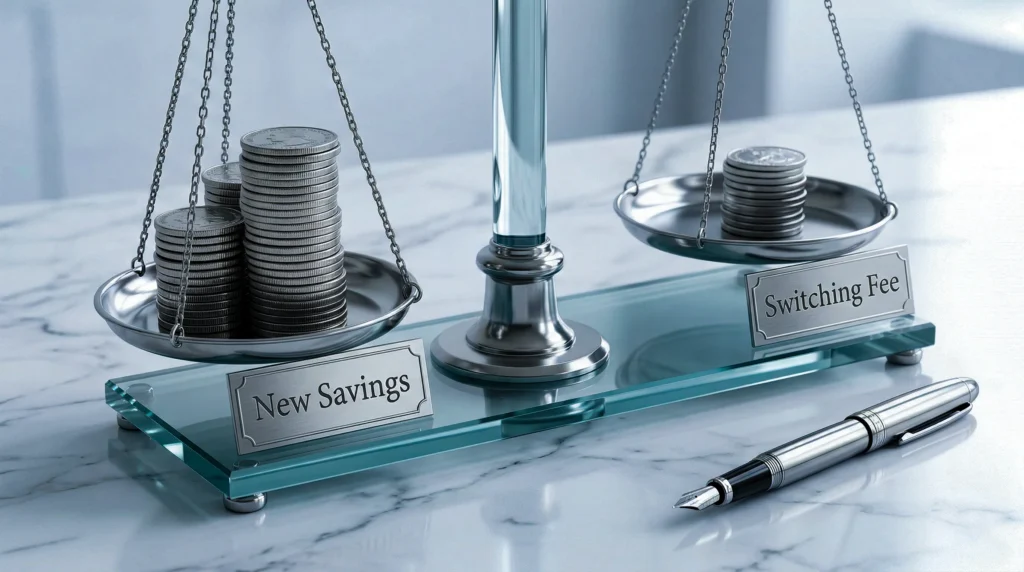
In most cases, there is no financial “penalty” for switching homeowners insurance mid-term, but some carriers may apply a “Short-Rate” cancellation fee that allows them to keep approximately 10% of your unearned premium as an administrative charge.
Understanding the difference between Pro-Rata and Short-Rate calculations is the difference between getting a full refund and being “robbed” of a hundred dollars by the fine print.
- Pro-Rata Cancellation (The Insurance Cop’s Standard): This is the fairest math. If you cancel exactly 6 months into a 12-month policy, the carrier returns 50% of the premium. Most modern carriers in 2026 use this method to remain competitive.
- Short-Rate Cancellation (The Red Flag): Some carriers use a “Short-Rate Table.” If you cancel early, they subtract a penalty (usually 10%) from your refund to cover the cost of setting up the policy.
According to data from the National Association of Insurance Commissioners (NAIC), short-rate penalties are becoming less common in the homeowners market, but they are still hidden in some legacy contracts.
Before you move, the Insurance Cop recommends asking your agent: “Is my policy subject to short-rate or pro-rata cancellation?” If it’s short-rate, you should calculate whether your savings with the new company are large enough to cover that 10% loss.
Why is switching homeowners insurance before your renewal date a smart move?
Switching your homeowners insurance before your annual renewal date allows you to lock in lower rates before a scheduled price hike, escape a hidden “loyalty penalty,” and secure a pro-rated refund for the months you didn’t use.
Many policyholders mistakenly believe that waiting for their renewal letter is the most orderly way to shop. In reality, the insurance industry often counts on this “passive” behavior. If you wait until the last minute, you are forced to make a rushed decision under the pressure of a ticking clock.
In the current 2026 market, premiums are shifting faster than annual cycles. If you wait for your renewal, you are at the mercy of the carrier’s newest rate filing. By switching mid-term, you seize the initiative.
As Mark Friedlander, Director of Corporate Communications at the Insurance Information Institute (III), points out: “In a hard market, shopping mid-term can yield significant savings because different carriers file rate increases at different times of the year. The company that was expensive for you in January might be your cheapest option in June.”
The Insurance Cop’s Mid-Term Audit Checklist
- The 60-Day Review: Don’t wait for the bill. Audit your policy every 6 months using an independent Replacement Cost Calculator.
- Capture the Refund: Since you are switching mid-term, that unearned premium check can be put directly into your savings or your escrow account to lower your future mortgage obligations.
Waiting for your policy anniversary is a choice, not a legal requirement. I recommend learning more about the mechanics of why does homeowners insurance automatically renew so you can decide exactly when to break the cycle and move to a better rate.
When should you wait to switch?

You should wait to switch your homeowners insurance if you have an open property damage claim, are less than 30 days away from a major home upgrade (like a new roof), or if a short-rate cancellation penalty exceeds your projected premium savings.
While the law allows you to switch at any time, doing so in these specific scenarios can trigger administrative headaches and financial penalties that wipe out any potential savings.
Before you pull the trigger on a mid-cycle change, the Insurance Cop requires you to evaluate these three tactical hold-zones:
- The Open Claim Window: If your home was just damaged by a storm, wait until the claim is closed and the repairs are complete. New carriers do not want to inherit “unresolved risk.”
- The 30-Day Roof Upgrade: If you are about to replace your roof, wait until the new roof is installed before shopping. A new roof can drop your premium by up to 20%. If you shop with the old roof, your quotes will be high. If you shop with the new roof, you get the absolute best rate.
- The Short-Rate Math: If your current carrier charges a 10% penalty for early cancellation, and your new policy only saves you $50 a year, it is mathematically wiser to wait until your renewal date to avoid the penalty.
While you have the legal freedom to move your policy whenever the math makes sense, the rules of the game change once you decide to sell the property. Before you schedule that final cancellation, I highly recommend reading my briefing on when to cancel homeowners insurance when selling a house so you don’t accidentally leave yourself uninsured during the closing process.
Can you change homeowners insurance during an active claim?
Yes, you can legally change your homeowners insurance company during an active claim, but it is highly discouraged because new insurance carriers are very hesitant to write a policy for a property with unresolved damage.
When an underwriter sees that you have an open claim for a roof leak or fire damage, they view the property as a high-risk liability. To them, there is a danger that the damage will get worse before it is fixed, or that they will be blamed for damage that occurred under the old carrier.
If you are determined to switch carriers while a claim is open, you will face steep hurdles:
- The Old Carrier’s Obligation: The carrier who insured the home on the day the damage occurred is legally required to pay for the repairs, even if you cancel the policy the next day.
- The Inspection Block: The new carrier will send an inspector to look at your house. If they see blue tarps on the roof or water damage in the drywall, they will likely issue a non-renewal or cancellation notice effective immediately.
The paperwork required to synchronize a mid-claim switch is an absolute headache. Unless your current carrier is acting in “Bad Faith” or refusing to pay a fair settlement, the safest play is to finish the repairs, close the claim, and then shop for a new provider.
How do you synchronize insurance dates for a seamless 12:01 AM handover?
To synchronize your insurance handover and prevent a dangerous coverage gap, you must set your new policy’s effective date to begin at exactly 12:01 AM on the same calendar day you choose to terminate your old coverage.
In the United States, almost all homeowners insurance policies, from State Farm to GEICO, operate on a standard 12:01 AM clock for both the start and end of a term. If you cancel your old policy on Monday but don’t start the new one until Tuesday, you are effectively uninsured for 23 hours and 59 minutes.
The Insurance Cop enforces a strict “No Gap” rule for two primary reasons:
- The Physical Risk: Disasters don’t check your policy dates. A fire or a burst pipe during a 24-hour gap is 100% your financial responsibility.
- The “Force-Placed” Trigger: If your mortgage lender detects even a one-day lapse in your coverage history, they may legally “force-place” a high-cost insurance policy on your loan, which can be difficult and expensive to remove.
As Sean Kevelighan, CEO of the Insurance Information Institute, often warns: “A gap in coverage is a red flag to future underwriters. Maintaining ‘continuous coverage’ is often a requirement for the best tier of rates. If you break that chain, you may pay a higher premium for the next three to five years.”

Your unearned premium refund is calculated by taking your total annual premium, dividing it by the number of days in the year to find your ‘daily rate,’ and multiplying that rate by the number of days remaining in your policy term at the time of cancellation.
Because most US homeowners pay for their insurance a full year in advance, the insurance company is essentially holding your money in trust for protection they haven’t provided yet. When you cancel mid-term, they are legally obligated to return the portion of the premium that is “unearned.”
However, as the Insurance Cop, I have to red-flag the “Hidden Math” carriers use. There are two primary ways they calculate your check:
- The Pro-Rata Method (The Honest Way): This is a clean split. If you cancel exactly 100 days into a 365-day policy, you get 265 days’ worth of money back. If your premium was $1,000, your refund would be approximately $726.
- The Short-Rate Method (The Penalty Way): Some carriers subtract a “cancellation fee”, usually 10% of the unearned portion, before sending your check. In the same example, instead of $726, you might only receive $653.
According to the National Association of Insurance Commissioners (NAIC), most states require carriers to issue your refund within 30 days of the cancellation date. If your insurance is paid through an escrow account, the check will still come to you, not the bank.
The freedom to switch means nothing if you don’t actually get your money back. I’ve policed the specific calculations and the 2026 timelines for these payouts in my technical guide on do you get a refund if you cancel homeowners insurance, which covers everything from pro-rata splits to the administrative penalties I red-flagged earlier.
The GTHI “Mid-Term Switch Feasibility Test” (Original Framework)
Before you initiate a mid-cycle cancellation, the Insurance Cop recommends running your quotes through our proprietary Feasibility Test. Just because you can change homeowners insurance at any time doesn’t always mean it’s the smartest move for your specific month.
| Criteria | Score: 5 (Go Ahead) | Score: 1 (Red Flag) |
| Premium Savings | Annual savings of $300 or more. | Savings of less than $50. |
| Cancellation Type | Pro-Rata (No Penalty). | Short-Rate (10% Fee). |
| Claim Status | No open or pending claims. | Open claim with active repairs. |
| Policy Comparison | Better or Equal “Replacement Cost” Math. | Lower price but “Actual Cash Value” roof. |
The Cop’s Verdict: If your total score is below 12, you are likely better off waiting until your official renewal date. If your score is above 16, you are losing money every day you wait to switch.
Frequently Asked Questions (FAQ)
When you cancel your policy, your insurance company is legally required to issue a refund for the “unearned premium.” This is the portion of the premium you paid for the months of coverage you will no longer receive. Most carriers will mail a physical check to your primary residence within 14 to 30 business days. If you paid your premium via credit card, some modern carriers like Lemonade or Hippo may offer to refund the balance directly back to your card.
Yes, you can switch, but the Insurance Cop warns that this is a high-difficulty move. Most standard carriers will not write a new policy for a home that is “under construction” or has active renovations (like a kitchen teardown). You may be forced to look at a “Builder’s Risk” policy or stay with your current carrier until the work is complete and a final inspection is performed. Switching during a renovation often leads to higher premiums because the new insurer views the open construction as an increased liability.
The best day to switch is one day after your mortgage payment is processed. If your insurance is paid through escrow, your lender usually sends the payment to your carrier about 15-30 days before your policy renews. If you switch after they send the money but before the renewal date, it creates a “Refund Loop” where you get a large check and your escrow account shows a temporary shortage. By timing the switch for the middle of your policy term, you ensure the refund math is cleaner and easier for your bank to track.
This is a “Red Flag” scenario known as Double Coverage. While it isn’t illegal, you cannot collect a payout from two different companies for the same loss (this is insurance fraud). If you forget to cancel, you are simply wasting money by paying two premiums. The Insurance Cop recommends sending your “Cancellation Request” the same hour you receive your new “Policy Binder.” Most carriers will backdate the cancellation to the start date of your new policy and issue a full refund for the overlap, provided you show proof of the new coverage.
Yes. In the US, almost all insurance companies report your coverage history to the C.L.U.E. Database (Comprehensive Loss Underwriting Exchange). When a new carrier runs your “Insurance Score,” they will see any “Lapse in Coverage” or “Cancellation for Non-Payment.” This can cause your new premium to be 20% to 50% higher, as you are now categorized as a high-risk policyholder. Always switch before your old policy cancels to maintain a “Continuous Coverage” record.
Conclusion: Policing Your Own Timeline
The primary takeaway is that the calendar should never be a barrier to better property protection. In the 2026 market, where rates are rising and policy language is becoming more restrictive, your ability to change homeowners insurance at any time is your ultimate financial lever.
By understanding your legal right to a pro-rata refund and the technical requirement of a 12:01 AM handover, you can exit a bad contract and enter a better one whenever the math makes sense.
As the Insurance Cop, my final directive is this: Don’t be a passive policyholder. The industry counts on your “loyalty” to keep premiums high. Take control of your transition, synchronize your dates, and never let your home go unprotected for even a single hour.
[NEXT STEP] Don’t Switch to the Wrong Coverage Limits
Now that you know you can switch at any time, make sure you are switching to the right amount. Many “cheap” quotes in 2026 achieve low premiums by underestimating the cost of labor and materials in your specific area.
Before you fire your current carrier, use our Free Replacement Cost Calculator Toolkit. Get precise, local math for your:
- Total Rebuild Value
- Roof and Window Replacement Costs
- HVAC and System Modernization