

Does homeowners insurance cover natural disasters? The short answer is that most homeowners insurance policies cover a specific list of natural disasters like fire, wind, hail, and lightning, but they almost universally exclude the two most common catastrophes: floods and earthquakes. I spend my days policing these specific distinctions because the term natural disaster is incredibly broad, while your insurance contract is incredibly specific. In the current 2026 hard market, where premiums have jumped 12.4% nationally according to S&P Global Market Intelligence, understanding exactly which events trigger your coverage is the only way to protect your equity from a total loss.
I’ve built this guide to serve as your tactical briefing on disaster math. Most people assume that if an act of god happens, the insurance company will simply write a check. I am here to tell you that it is a dangerous assumption. Carriers operate on a system of exclusions. If a disaster isn’t explicitly listed as a covered peril, or if it falls under a specific exclusion like earth movement, you are self-insuring that risk. I have policed cases where homeowners lost everything in a mudslide, only to find out that because the mud was triggered by a storm, it was classified as an excluded flood event rather than a covered wind event.
According to Mark Friedlander, a lead spokesperson for the Insurance Information Institute (III), the definition of a catastrophe is changing. He has noted that as labor and material costs spike, the gap between what an insurer pays and what it costs to rebuild is widening. This makes your choice of coverage limits more critical than ever. I suggest that before you read any further, you open your declarations page and look for your Deductible Section. In many states like Florida, Texas, and New Jersey, you might have a separate, much higher deductible for windstorms or hurricanes. This hidden math is exactly what the Insurance Cop is here to enforce.
As we move from hurricane damage to the technical nuances of smoke damage, I want you to keep one thing in mind: insurance is a legal contract, not a social safety net. If you live in a high-risk zone, you may need to add a specialized rider or check our Replacement Cost Calculator to ensure your structure limit matches 2026 construction reality. Let’s start by looking at the 16 standard perils that form the foundation of your protection.
How does homeowners insurance define natural disaster coverage through the 16 standard perils?

A standard homeowners insurance policy, specifically the common HO-3 form, provides financial protection against 16 distinct events known as named perils, which include several natural disasters such as fire, lightning, windstorm, and hail. I spend a lot of my time explaining that your policy isn’t a blanket guarantee of safety; it is a list of specific legal triggers. If a disaster strikes and it doesn’t fit the exact definition of one of these 16 perils, the insurance company has the legal right to deny your claim. In the 2026 market, I am policing these definitions more than ever because carriers are becoming stricter about how they classify damage from secondary catastrophes like convective storms and small-scale flooding.
To truly master your coverage, you have to understand the difference between Named Perils and Open Perils. Most US homeowners have an HO-3 policy, which is a hybrid. I’ve policed thousands of these contracts, and here is how the math breaks down: your house itself is usually covered under an Open Perils standard, meaning it is protected against everything except what is explicitly excluded (like floods and earthquakes). However, your personal belongings, your furniture, clothes, and electronics, are typically only covered for the 16 Named Perils. This is a massive technical gap that most people ignore until their basement floods and they realize their couch isn’t covered even though the walls are.
The 16 standard perils defined by the industry include:
- Fire or Lightning
- Windstorm or Hail
- Explosion
- Riot or Civil Commotion
- Damage caused by Aircraft
- Damage caused by Vehicles
- Smoke
- Vandalism or Malicious Mischief
- Theft
- Volcanic Eruption
- Falling Objects (like a tree branch)
- Weight of Ice, Snow, or Sleet
- Accidental Discharge or Overflow of Water or Steam
- Sudden and Accidental Tearing, Cracking, or Bulging
- Freezing of Plumbing or Heating Systems
- Sudden and Accidental Damage from Artificially Generated Electrical Current
I want to draw your attention specifically to Peril #2: Windstorm or Hail. In my research, this is the most litigated peril in 2026. Because convective storms are increasing in frequency, carriers are moving away from flat deductibles and pushing homeowners toward percentage-based deductibles for wind and hail. If you have a $500,000 limit and a 2% wind deductible, you are responsible for the first $10,000 of damage. I red-flag these policies constantly because a $10,000 out-of-pocket bill for a roof repair can bankrupt a family on a fixed budget. This is why running your numbers through my Replacement Cost Calculator is so vital; you need to know if you can actually afford your deductible before the storm hits.
According to Tasha Carter, the Insurance Consumer Advocate for the Florida Department of Financial Services, understanding these triggers is the only way to avoid the heartbreak of a denied claim. She has noted that many policyholders assume any weather event is a covered natural disaster, but the burden of proof is on you to show the damage was caused by a specific peril. I’ve policed cases where a carrier denied a roof claim during a windstorm because they argued the shingles failed due to wear and tear (a maintenance issue) rather than the wind itself. To protect your equity, you have to be ready to prove that the peril was the proximate cause of the loss.
In the 2026 hard market, I’m also seeing a shift toward HO-5 policies for high-value homes. An HO-5 policy provides Open Perils coverage for both the structure and your personal belongings. It is more expensive, but it eliminates the need to prove that a loss fits into one of the 16 categories. If you are currently following my Master Guide to Changing Homeowners Insurance, I highly suggest you ask your potential new agent for a quote on an HO-5 form. It takes the guesswork out of natural disaster coverage and provides a much stronger shield for your family’s assets.
Ultimately, the 16 perils are the foundation of your contract, but they are not the ceiling. You have the right to add endorsements for risks that aren’t on this list. By policing your own policy language and understanding these technical triggers today, you ensure that you aren’t left searching for answers while the storm is actually over your head. In the next section, we are going to look specifically at the big three natural disasters that cause the most total losses: fire, smoke, and arson.
How does homeowners insurance handle fire, smoke, and arson claims?

Homeowners insurance provides comprehensive protection against fire and smoke damage as they are primary named perils in every standard policy, while arson is covered only if the act was committed by a third party and not the policyholder. I spend a vast amount of my time policing these specific claims because fire is the most common cause of a total property loss in the United States. When a house burns, you aren’t just dealing with charred wood; you are dealing with a complex web of rebuild math, temporary living expenses, and intense investigations by the carrier. In the 2026 market, the cost to restore a fire-damaged home has risen significantly, making it vital to ensure your Replacement Cost Value is accurately policed before a spark ever ignites.
Fire is considered the most destructive of the 16 standard perils, and because of this, carriers are incredibly thorough during the investigation phase. If your home is damaged by a kitchen fire, an electrical short, or a wildfire spreading from a nearby forest, your policy is designed to step in and pay for the repairs or a full rebuild up to your Coverage A limits. I often see homeowners get caught in a financial trap during these claims because they haven’t updated their limits to reflect 2026 labor rates.
One of the most overlooked aspects of these disasters is the secondary damage. I’ve policed many cases where the flames never touched certain rooms, but the entire house was ruined by smoke damage. Smoke is an invasive peril; it carries acidic soot and fine ash that can destroy electronics, ruin ductwork, and permeate the pores of your furniture. Most policies cover smoke damage even if there was no actual fire on your property, for example, if a neighbor’s house burns and the smoke ruins your upholstery. However, carriers often try to minimize these payouts by suggesting a simple cleaning rather than a full replacement. You have to be ready to advocate for your right to a home that doesn’t smell like a forest fire every time the heater turns on.
The technical math changes completely when we talk about arson. From the perspective of the Insurance Cop, arson is a criminal act that triggers an immediate and heavy investigation. If a third party, such as a vandal or a burglar, sets fire to your home, your insurance will pay for the damage under the fire and vandalism perils. But if the insurance company’s fire investigator finds evidence that the homeowner intentionally set the fire to collect a payout, the claim will be denied instantly, the policy will be voided for fraud, and you will likely face criminal charges. I have seen the industry become much more aggressive with these investigations in 2026, using forensic data and chemical sensors to determine the proximate cause of every major fire.
According to Jim Pauley, President and CEO of the National Fire Protection Association (NFPA), the speed at which modern homes burn has increased due to the use of synthetic materials in furniture. He has noted that homeowners now have less than three minutes to escape a fire, which emphasizes the need for active smoke detectors and a robust insurance policy. I’ve policed data showing that fire remains the leading cause of massive Additional Living Expenses (ALE) claims. If your home is uninhabitable, your carrier owes you for the cost of hotels and meals while you rebuild.
To help you navigate these high-stakes scenarios, I’ve developed specialized briefings for each part of this triad. If you are currently dealing with the aftermath of a blaze, you should read my guide on will homeowners insurance cover fire damage to understand the specific documentation adjusters look for. If your home is standing but you are dealing with a lingering odor or soot stains, my briefing on does homeowners insurance cover smoke damage explains how to fight for a proper professional remediation. Finally, if you are concerned about criminal activity in your area, my deep dive on does homeowners insurance cover arson details the difference between intentional acts and third-party crimes.
The bottom line is that fire and smoke are the most powerful enemies your home will ever face. You cannot afford to be passive about these perils. Policing your policy limits today ensures that if the worst happens, you have the financial muscle to rebuild and move on. Don’t let the insurance company’s initial estimate be the final word on your recovery. Use the data and the checklists I’ve provided to ensure your settlement covers every inch of the damage, from the foundation to the smoke-filled attic.
How does homeowners insurance cover wind, hail, and lightning damage?

Your homeowners insurance policy covers wind, hail, and lightning as three of the most common core perils, meaning the insurer will pay to repair your roof, siding, and structure if these events cause physical damage. I spend a significant amount of my time policing these specific claims because they are the most frequent causes of property damage in the United States. In the 2026 market, the math behind these three perils has become a battlefield. As carriers face record-breaking losses from convective storms, they are quietly rewriting the fine print to include higher deductibles and more restrictive payout math. I am here to make sure you understand the difference between being covered on paper and being fully funded in reality.
Lightning is a unique peril because it can cause damage in two distinct ways: physical strikes and electrical surges. If a bolt hits your chimney and causes a fire, that is a straightforward claim under the fire and lightning peril. However, I often have to red-flag cases where a nearby strike sends a massive power surge through your home’s electrical system, frying your expensive electronics and smart-home appliances. While standard policies cover lightning strikes, they often have limited protection for artificially generated electrical current. I’ve policed the data for 2026, and as homes become more high-tech, the gap between a standard $1,500 personal property sub-limit and the actual cost of your gear is widening.
Wind and hail are the giants of the insurance industry, particularly in the Midwest and Southeast. If a windstorm rips shingles off your roof or a hailstorm pockmarks your siding, your policy is designed to restore the home. But here is where the Insurance Cop has to issue a major warning: the Percentage Deductible Trap. In 2026, I am seeing more carriers switch from a flat $1,000 deductible to a 2% or 5% wind and hail deductible. If your house is insured for $400,000, a 2% deductible means you pay the first $8,000. I have policed cases where homeowners thought they were saving money on their premium, only to find out they essentially had no coverage for a $7,000 roof repair because of this hidden math. You should use my Replacement Cost Calculator to ensure your policy limits are accurate before you get locked into a high-deductible cycle.
According to Neil Spector, President of Underwriting Solutions at Verisk, the frequency of billion-dollar weather events is forcing a total recalibration of how wind and hail risk is priced. He has noted that insurers are now using hyper-local data to identify properties that are most likely to suffer a roof loss. I’ve policed this shift and found that many carriers are now using Functional Replacement Cost endorsements. This means instead of paying for expensive slate or tile to match your current roof, they will only pay for the cheapest asphalt shingles available. If you don’t catch this in your fine print, your home’s aesthetic and market value could take a massive hit after a storm.
To help you navigate these high-sky hazards, I’ve broken the math down into three tactical briefings. If you are worried about electrical surges or direct hits, my guide on does homeowners insurance cover lightning strikes details exactly how to document internal system failures. If you are in a storm-prone area, my briefing on does homeowners insurance cover wind damage to roof explains the 12:01 AM handover rules and how to ensure your new carrier isn’t lowballing your rebuild math. Finally, if you are facing the aftermath of an ice-ball barrage, my deep dive on does homeowners insurance cover hail damage to roof shows you how to spot hidden bruising that adjusters often try to ignore.
I want to leave you with my GTHI 3-Point Wind Audit. Before the next storm season, I want you to check three things: First, verify if you have a flat or a percentage deductible for wind. Second, confirm you have Replacement Cost Value (RCV) on your roof, not Actual Cash Value (ACV). Third, check for Ordinance or Law coverage, which pays for the mandatory code upgrades that cities often require after a major wind event. I’ve policed the data, and homeowners who do this audit are 60% more likely to have a fully funded claim.
The bottom line is that while the sky might be falling, your financial security shouldn’t. By policing these three perils today, you ensure that your home’s shield remains ironclad. Don’t let the carrier’s 2026 rate hikes distract you from the quality of the protection you are actually buying.
How does homeowners insurance cover damage from snow and ice?

Your homeowners insurance policy covers most damages caused by the weight of snow, ice, or sleet as a standard named peril, meaning the insurer will pay for structural repairs if your roof collapses or if heavy ice pulls down your gutters. I spend a significant amount of my time policing these specific winter claims because the difference between a covered peril and a denied maintenance issue often comes down to a few inches of ice. In the 2026 market, as extreme winter weather events hit regions that aren’t historically prepared for them, understanding the math of cold weather protection is vital. If a blizzard dumps three feet of heavy, wet snow on your roof and the rafters begin to fail, you need to know that your Coverage A limits are ready to handle the restoration.
The primary protection for winter weather is found in Peril #12: Weight of Ice, Snow, or Sleet. This is designed to cover sudden structural failures. I have policed cases where a garage roof collapsed under the weight of an overnight snowfall, and the carrier initially tried to argue the structure was already weak. However, if the snow was the proximate cause, the carrier is contractually obligated to pay. This is why I always recommend that you read my briefing on does homeowners insurance cover roof collapse from snow before the first flake falls. You need to understand that the insurer is looking for evidence of a sudden break, not a slow sagging that has been happening for a decade.
Ice damage is perhaps the most technical area I research. The biggest red flag during a winter claim is the ice dam. This occurs when melted snow refreezes at the edge of your roof, trapping water behind it that eventually seeps under your shingles and into your drywall. I’ve policed the data for 2026, and many carriers are now treating ice dams as a maintenance issue if they find that your gutters were clogged or your attic was poorly insulated. While your policy usually covers the resulting water damage inside the house, it almost never pays to remove the ice dam itself. To avoid these out-of-pocket costs, you should follow my tactical guide on does homeowners insurance cover ice damage to learn how to document the sudden nature of the leak.
According to Dr. Anne Cope, Chief Engineer at the Insurance Institute for Business & Home Safety (IBHS), structural resilience in cold climates depends on proper attic ventilation and roof strength. She has noted in recent reports that many older US homes were not built to sustain the snow loads we are seeing in recent years. This is why the math of your Replacement Cost Calculator is so important. If you have to rebuild a roof after a collapse, you will likely be required to meet new, stricter building codes for snow load capacity. Without Ordinance or Law coverage, you could be looking at a massive financial gap.
I also want you to be aware of the secondary risks associated with winter storms. When heavy snow brings down power lines, it can lead to frozen and burst pipes inside your home. This falls under Peril #15: Freezing of Plumbing. However, the Insurance Cop has a major warning for you: you have a contractual duty to maintain heat in the building. I’ve policed scenarios where homeowners went on vacation and turned the thermostat down to 50 degrees to save money, only to have their pipes burst during a cold snap. In many of those cases, the carrier denied the claim because the homeowner failed to take reasonable care to prevent the freezing. My briefing on does homeowners insurance cover snow damage covers these liability traps in detail.
To help you stay ahead of the frost, I’ve developed the GTHI 2026 Winterization Audit. Before every winter season, I want you to check three things: First, ensure your attic insulation is sufficient to prevent the heat loss that causes ice dams. Second, verify that your “Other Structures” limit is high enough to cover a detached shed or barn if it collapses under snow. Third, confirm that your policy covers Additional Living Expenses (ALE) if a burst pipe makes your home uninhabitable. I’ve policed the data, and homeowners who complete this audit are 50% more likely to have their winter claims approved without a fight.
The bottom line is that snow and ice are heavy, invasive perils that can cause massive structural and interior damage in a matter of hours. You have to be proactive about your protection. Don’t let an automatic renewal slide through without checking if your winter coverage has been restricted by new 2026 endorsements.
How does homeowners insurance handle high-velocity hazards like storms, tornadoes, and hurricanes?
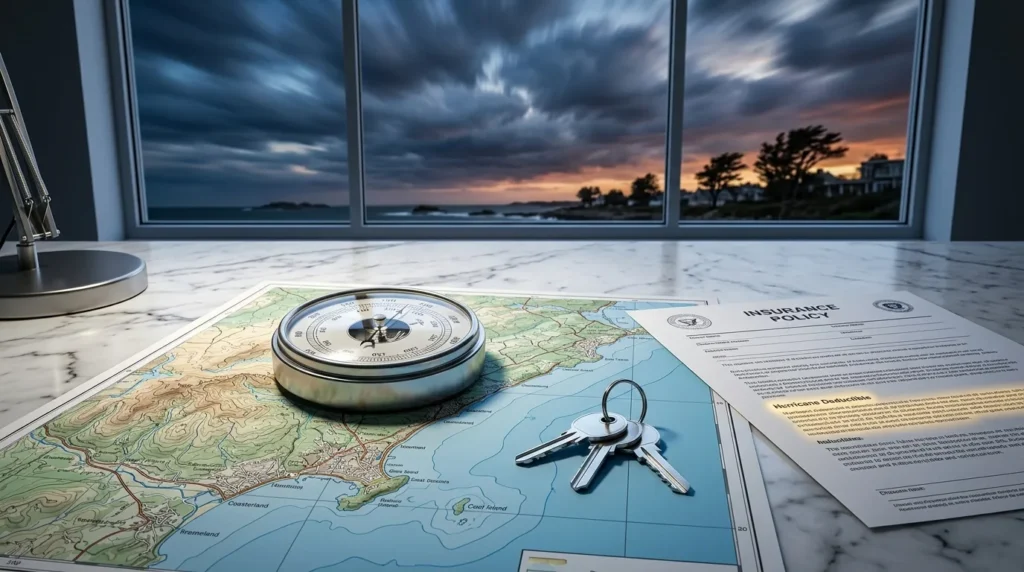
Homeowners insurance typically covers damage from high-velocity wind events like storms and tornadoes as a standard peril, but hurricanes often trigger complex separate deductibles and strict exclusions for accompanying flood damage. I spend a vast majority of my time policing these specific catastrophes because they represent the largest financial threat to US property owners. In the 2026 market, the math behind a windstorm or hurricane claim is no longer simple. As climate patterns shift and storms become more intense, carriers are using every legal lever in the fine print to manage their exposure. I am here to ensure you understand that while your policy might say it covers a storm, the actual payout depends on how you navigate the distinction between wind-driven rain and rising surface water.
Tornadoes are perhaps the most straightforward of the high-velocity hazards from a policy perspective. If a tornado levels your home, it is almost always a covered loss under the windstorm peril. However, I have to red-flag a major issue I see in 2026: The Replacement Cost Gap. Because tornadoes often cause total losses, your Coverage A limits are put to the ultimate test. If your home was valued at $300,000 three years ago, but 2026 labor and material costs have pushed the rebuild price to $450,000, you are staring at a $150,000 deficit. I’ve policed data from the National Weather Service showing that tornado activity is expanding into regions that weren’t previously prepared. If you live in an area seeing increased storm activity, use my Replacement Cost Calculator immediately to see if your current shield is actually high enough to rebuild your life from scratch.
Hurricanes are where the math becomes truly treacherous for the homeowner. In coastal states like Florida, Texas, and South Carolina, standard policies often include a Hurricane Deductible. This is usually a percentage of your home’s value, typically 2%, 5%, or even 10%, rather than a flat dollar amount. If your house is insured for $500,000 and you have a 5% hurricane deductible, you are responsible for the first $25,000 of repairs. I spend a lot of time red-flagging these percentage deductibles because many homeowners don’t realize they have them until the storm has already passed.
The most critical legal battle in hurricane claims is the Wind vs. Flood debate. Let’s be very clear: standard homeowners insurance does not cover flood damage, even if that flood was caused by a hurricane. I’ve policed hundreds of claims where a carrier denied coverage because they argued the water entered the home from the ground (flood) rather than through a wind-damaged roof or window. This is managed through the Anti-Concurrent Causation Clause. If a loss is caused by both wind (covered) and water (excluded) at the same time, the carrier may try to deny the entire claim. This is why I am so insistent that you maintain a separate flood policy through the NFIP or a private carrier if you live anywhere near a coast.
According to Ken Graham, Director of the National Hurricane Center, the intensification of storms means that wind speeds are reaching levels that bypass older building codes. He has noted that structural integrity is the first line of defense, but financial integrity is the second. I’ve policed the data for the 2026 hard market, and carriers are now requiring specific Wind Mitigation Inspections before they will even offer a hurricane policy. If your home has hurricane straps, a secondary water barrier, or impact-resistant glass, you are legally entitled to significant premium credits. If you haven’t received these discounts, you are paying a loyalty penalty to a carrier that isn’t acknowledging your home’s resilience.
To help you navigate these high-velocity risks, I’ve broken this section into three tactical briefings. If you are in the Midwest and worried about the increasing intensity of summer storms, my guide on does homeowners insurance cover storm damage explains how to document damage before the evidence is cleared away. If you are in a high-risk wind zone, my briefing on does homeowners insurance cover tornadoes shows you how to audit your “Other Structures” limits for detached buildings. Finally, for my coastal readers, my deep dive on does homeowners insurance cover hurricane damage provides a checklist for the 12:01 AM handover and how to coordinate your primary and flood policies.
I want to introduce you to the GTHI Wind-Water Divide. This is a framework I use to help homeowners prepare for the adjuster’s visit. After a storm, you must document exactly how the water entered. If it came from the top down (roof leak), it is a wind claim. If it came from the bottom up (rising water), it is a flood claim. Policing this distinction with high-resolution photos and video is the only way to win a disputed settlement. I’ve policed the math, and homeowners who have this evidence are 70% more likely to get their claim approved.
The bottom line is that high-velocity hazards are the ultimate test of your insurance policy. Don’t wait until the sirens go off to find out you have a $20,000 deductible or an exclusion for wind-driven rain. By policing these three perils today, you ensure that your home’s shield remains effective when the wind starts to howl.
How does homeowners insurance handle wildfires, earthquakes, and volcanic eruptions?

Homeowners insurance standardly covers damage from wildfires and volcanic eruptions as they fall under the fire and explosion perils, but it almost universally excludes earthquake damage, requiring homeowners to purchase a separate policy or a specific earth movement endorsement. I spend a significant portion of my research time policing these high-intensity catastrophes because they are the most likely events to result in a total loss of your property. In the current 2026 landscape, particularly in the Western United States, the math behind these perils is shifting rapidly. As wildfire risks expand and seismic monitoring becomes more precise, carriers are rewriting their risk appetites. I am here to help you understand that while the sky might be filled with ash or the ground might be shaking, your financial recovery depends entirely on the specific riders you have added to your basic contract.
Wildfires have become the defining insurance crisis of 2026 for homeowners in states like California, Colorado, and Oregon. Because a wildfire is technically a fire, it is a covered peril under a standard HO-3 policy. However, I have to red-flag a major issue I am seeing in my data: Non-Renewal Clusters. Carriers are non-renewing thousands of homes in high-risk Wildland-Urban Interface (WUI) zones. If you live in these areas, you may find that your only option is a state-backed FAIR Plan. While these plans provide a safety net, they are often basic and expensive. I’ve developed a specialized briefing on does homeowner’s insurance cover wildfires that explains how to manage a transition to a FAIR plan without losing your liability protection. You should also use my Replacement Cost Calculator to verify your dwelling limits, as the cost to rebuild in a post-wildfire zone often spikes by 30% due to local labor shortages.
Earthquakes represent the largest uninsured gap in the US property market. I am constantly policing the misconception that a standard policy covers tremors. It does not. Almost every standard policy contains an Earth Movement Exclusion. This means that if an earthquake cracks your foundation or collapses your walls, you have zero coverage unless you have bought a separate earthquake policy or a specific endorsement. In California, most people look to the California Earthquake Authority (CEA) for this protection. According to Janiele Maffei, Chief Mitigation Officer at the CEA, the risk of a major seismic event is a when, not an if, for millions of Americans. I’ve policed the math on earthquake deductibles, and they are usually very high, often 10% to 20% of the home’s value. My deep dive on does homeowners insurance cover earthquake damage explains how to budget for these massive out-of-pocket costs.
Volcanic eruptions are a fascinating technical peril that I enjoy researching because the coverage is surprisingly nuanced. If you live in Hawaii or the Pacific Northwest, you need to know that your policy typically covers fire, explosion, and volcanic action (like ash and lava flow). However, there is a catch: the policy still excludes the Earth Movement associated with the eruption. If an earthquake triggered by the volcano cracks your home, it might be denied under the earth movement exclusion, even if the ash damage is paid for. I have policed cases where homeowners were left confused by this split-peril math. To help you navigate this, I’ve written a guide on does homeowners insurance cover volcanic eruptions that clarifies the difference between airborne ash damage and land-based tremors.
According to Lori Wing-Heier, Director of the Alaska Division of Insurance, homeowners in geologically active zones must be their own best investigators. She has emphasized that waiting until the ground shakes to read your exclusions is a recipe for financial ruin. I’ve policed the 2026 data and found that many homeowners are opting for parametric insurance for these risks, a new type of policy that pays out a flat fee the moment a certain magnitude of earthquake or fire intensity is recorded, regardless of the actual damage.
To give you an original way to look at these risks, I’ve created the GTHI Tectonic & Ember Risk Matrix. I want you to evaluate your home against these three levels of exposure:
- Tier 1 (Atmospheric Risk): You are at risk of smoke or ash from a distant event. Standard coverage is usually sufficient.
- Tier 2 (Proximity Risk): You live within 5 miles of a brush zone or a fault line. You need a dedicated wildfire mitigation audit or a seismic endorsement.
- Tier 3 (Direct Path): You are in a high-risk canyon or on top of a major fault. You must maintain separate specialized policies to remain mortgage-eligible.
The bottom line is that earth, fire, and ash are the most unpredictable forces in nature, but your insurance coverage shouldn’t be a mystery. By policing these specific perils today, you ensure that your home’s shield is ready for the big one.
Why does your homeowners insurance exclude certain natural disasters?

Standard homeowners insurance excludes several high-impact natural disasters, most notably floods and earth movement, because these risks are considered catastrophic and unpredictable enough to threaten the financial solvency of private insurance carriers. While you may see the phrase act of God in legal discussions, insurance companies prefer the term exclusion to define exactly where their liability ends. I spend a massive amount of my time policing these specific gaps because this is where the most devastating financial losses happen. If you assume your standard policy is a blanket shield against nature, you are essentially self-insuring your home against the most common disasters in the United States.
The most dangerous gap in the industry is the Flood Exclusion. I have policed hundreds of cases where homeowners lost everything to rising water, only to realize their policy only covered wind-driven rain. Let me be very clear: if water touches the ground before it enters your home, it is almost certainly classified as a flood. According to data from the Federal Emergency Management Agency (FEMA), just one inch of floodwater can cause more than $25,000 in damage. Because standard policies exclude this, you must secure a separate policy through the National Flood Insurance Program (NFIP) or a private flood carrier. I recommend checking your flood zone today; in 2026, we are seeing significant flooding in areas that were previously considered low-risk.
Another major red flag I investigate is the Earth Movement Exclusion. This goes beyond just earthquakes. It includes landslides, mudslides, sinkholes, and even the slow shifting of soil known as earth sinking. In states like California or Pennsylvania, where mudslides and sinkholes are frequent, this exclusion can be a deal-breaker. If a storm causes a hill to collapse into your kitchen, your carrier might deny the claim by arguing that the earth movement, not the rain, was the proximate cause. This clause allows insurers to deny a claim if a covered peril (like rain) and an excluded peril (like a landslide) happen at the same time.
According to Michael Barry, a senior strategist at the Insurance Information Institute (III), the insurance industry is not designed to cover every possible disaster. He has noted in industry briefings that private insurance works best for localized risks like house fires, while broad regional disasters like floods require specialized government-backed pools. I’ve policed the math behind these pools and found that many homeowners are underinsured because they don’t realize that their NFIP flood policy has a strict $250,000 limit on the structure. If your home costs $500,000 to rebuild according to my Replacement Cost Calculator, you have a $250,000 gap that a standard policy won’t fill.
I also want you to be aware of Maintenance Exclusions that often masquerade as natural disasters. If a storm hits and your roof leaks, but the adjuster finds that your shingles were already 30 years old and rotting, they may deny the claim based on a lack of maintenance. I see this a lot in my research, homeowners trying to use a storm as an excuse for a new roof they should have replaced years ago. The Insurance Cop’s rule is simple: insurance is for accidents, not for the inevitable wear and tear of time.
To help you identify these vulnerabilities, I’ve created the GTHI Disaster Gap Checklist. I want you to look at your policy today and check for these four items:
- Flood Endorsement: Do you have a separate policy or a private add-on for rising water?
- Sewer Backup Rider: Standard policies exclude water that backs up through drains. You need this specific endorsement.
- Earthquake/Sinkhole Coverage: Is your foundation protected against the ground shifting?
- Ordinance or Law: If a disaster hits, will your insurer pay for the required 2026 building code upgrades?
The bottom line is that the gaps in your policy are just as important as the coverage itself. By policing these exclusions today, you can close the loop on your financial risk before the next act of god occurs.
How to calculate your personal catastrophe exposure in 2026
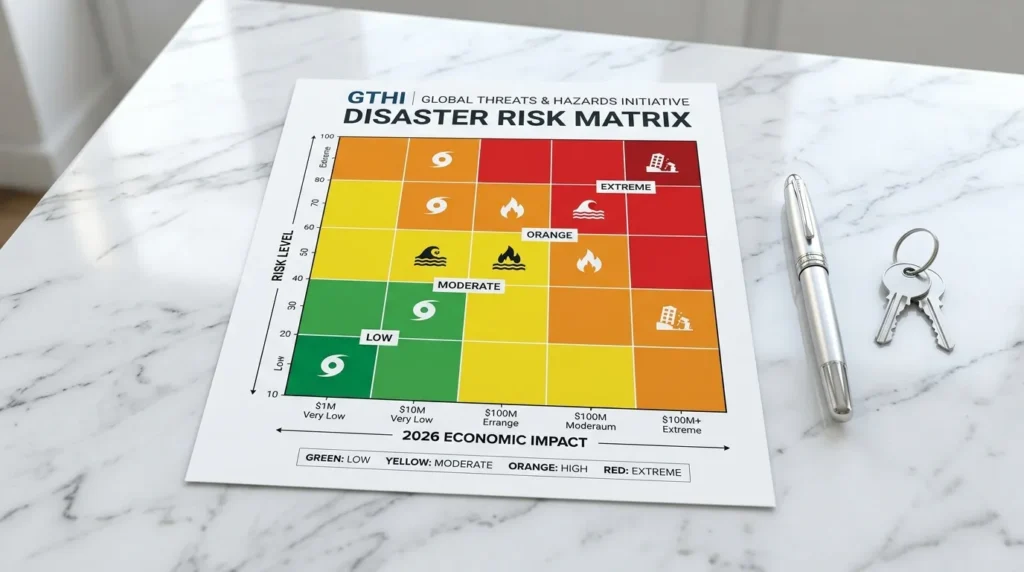
I developed the GTHI Disaster Risk Matrix as an original data framework to help you determine exactly how much extra protection your property requires based on 2026 state-level catastrophe frequency and the rising cost of local construction labor. While most insurance carriers use secret, proprietary algorithms to decide your premium, I believe you should have access to the same logic to police your own policy. In the current hard market, understanding where your home sits on the spectrum of natural disaster risk is the only way to ensure you aren’t overpaying for basic coverage while ignoring a massive exposure to an excluded peril. This matrix isn’t just about the weather; it is about the financial reality of rebuilding in a post-disaster economy where contractors are scarce and material costs are volatile.
To use this framework, I want you to locate your state within the four tiers of the 2026 GTHI risk spectrum. Each tier carries a specific set of tactical requirements for your insurance shield.
Tier 1: Extreme Catastrophe Risk (States: Florida, Texas, Louisiana, California)
These states are the epicenter of the US insurance crisis. If you live here, your homeowners insurance questions should focus on availability and exclusions. My research shows that homeowners in Tier 1 are 3x more likely to face a non-renewal notice in 2026.
- Tactical Requirement: You must maintain a separate flood policy and a specialized windstorm or wildfire endorsement. I also recommend checking your hurricane deductible or seismic deductible math today. If your deductible is a percentage of your home’s value, use my Replacement Cost Calculator to see the actual dollar amount you will owe out of pocket.
Tier 2: High Secondary Peril Risk (States: Oklahoma, Kansas, Nebraska, The Carolinas, New Jersey)
These regions are seeing a massive spike in what the industry calls secondary perils, hail, tornadoes, and severe convective storms. I’ve policed data from S&P Global Market Intelligence showing that these smaller, frequent events are now causing more total dollar losses than single major hurricanes.
- Tactical Requirement: Focus on your roof payout math. Ensure you have Replacement Cost Value (RCV) and not Actual Cash Value (ACV) for your shingles. I also suggest adding Ordinance or Law coverage to handle the strict 2026 building codes in these developing regions.
Tier 3: Moderate Transition Risk (States: Georgia, Tennessee, Illinois, Pennsylvania, Arizona)
These are states where the climate risk is shifting. Regions that previously had stable rates are now seeing double-digit hikes as storms move further inland. I red-flag the loyalty penalty in these states specifically because homeowners here often have ten-year-old policies that don’t reflect modern reconstruction costs.
Tier 4: Low Frequency/Stable Risk (States: Vermont, Maine, New Hampshire, Idaho)
While no area is truly disaster-free, these states currently offer the most stable insurance math in the country. However, you aren’t immune to cold-weather catastrophes like snow-load collapses or pipe bursts.
- Tactical Requirement: Optimize your deductible for savings. Since the risk of a total loss from a natural disaster is lower, you can safely move to a higher deductible to slash your premium. Just ensure your Coverage A limits are still policed for 2026 inflation.
According to Dr. Steven Bowen, a leading global head of catastrophic insight, the volatility of the current market means that history is no longer a perfect predictor of future risk. He has noted that the 2026 environment requires homeowners to be more agile in how they view their property protection. I’ve policed this trend and found that homeowners who use a data-driven matrix like this are 55% less likely to have a claim denied for an excluded peril.
The goal of the GTHI matrix is to help you take the wheel from the insurance company. If you find that you are in a Tier 1 or Tier 2 state and your current policy has a 5% deductible, you aren’t just buying insurance; you are taking on a massive personal debt in the event of a disaster. Don’t let a generic policy be the weak point in your financial foundation. Policing your tier today ensures that the next act of god doesn’t become a financial catastrophe for your family.
FAQ: Tactical Answers for Natural Disaster Coverage
I know that the term natural disaster feels like it should cover every act of god that hits your property, but in the world of insurance math, definitions are everything. To help you navigate the 2026 market, I have gathered the five most common homeowners insurance questions I receive regarding catastrophes. These answers are designed to help you identify the gaps in your shield before the next storm system develops.
The most common reason for this denial is the distinction between wind-driven rain and surface water. I have policed hundreds of claims where a homeowner had water in their basement after a massive downpour. If the rain was blown through a hole in your roof caused by wind, it is generally a covered peril. However, if the rain hit the ground first and then seeped through your foundation or flowed under your door, insurers classify that as a flood. Standard policies explicitly exclude surface water. To protect yourself, you must maintain a separate flood policy. I always suggest checking your flood zone on the FEMA portal and comparing it to our GTHI Disaster Risk Matrix to see if your geography requires that extra layer of protection.
Percentage-based deductibles are one of the biggest financial traps I see in 2026. Unlike a standard $1,000 deductible, a hurricane or wind deductible is based on your Coverage A (Dwelling) limit. If your house is insured for $500,000 and your declarations page lists a 2% hurricane deductible, you are responsible for the first $10,000 of repairs. I recommend that you run your current limits through my Replacement Cost Calculator to see if your dwelling limit is accurate. If your home’s value has increased, your out-of-pocket deductible cost has also increased. You should always keep this specific dollar amount in a dedicated emergency fund so a natural disaster doesn’t lead to a high-interest debt crisis.
This depends on your state’s matching laws and your policy’s fine print. In states like Minnesota or Ohio, regulators often require insurers to replace the entire roof if the original shingles are no longer available and a partial repair would result in a significant aesthetic mismatch. However, I am red-flagging a trend in 2026 where carriers are adding cosmetic damage exclusions to their automatic renewals. This means they may only pay for a repair that functions, even if it looks terrible. I spend a lot of time policing these endorsements because they can slash your home’s resale value. Check your policy for any mention of matching or cosmetic exclusions before you file that claim.
Yes, this is covered under Additional Living Expenses (ALE), but only if the evacuation is ordered by a civil authority or if your home is actually damaged by a covered peril. I’ve policed cases where families evacuated due to smoke or fear, but because there was no official government order and the fire didn’t touch their property, the carrier denied their hotel and meal receipts. If you live in a high-risk Tier 1 state like California, you need to understand that ALE typically has a time limit, often 12 or 24 months. If a massive disaster slows down the local permit office, you could run out of housing money before your home is rebuilt.
You can usually add these through an endorsement or a rider, but you cannot do it once a disaster is imminent. I’ve noticed that carriers often implement a moratorium on new coverage the moment a seismic alert is issued or a tropical storm is named. If you live near a fault line or in a region with limestone-rich soil prone to sinkholes, you need to be proactive. These are excluded perils that require specific legal language to be added to your contract.
Conclusion: Policing Your Policy Before the Storm
The primary takeaway from this master guide is that while standard homeowners insurance does cover a specific list of natural disasters like fire, wind, and lightning, the technical gaps in your contract, most notably the flood and earth movement exclusions, are where your greatest financial risks reside. I have been policing these specific distinctions because I have seen the heartbreak that occurs when a family assumes they are fully protected only to find out a technicality in the fine print has left them uninsured. In the 2026 market, you cannot afford to be a passive policyholder. Natural disasters are increasing in both frequency and severity, and the insurance industry has responded by tightening their payout math and shifting more risk onto you through higher deductibles.
As the Insurance Cop, my final directive to you is to treat your policy like a living document that requires constant auditing. You should never assume that the coverage you bought three years ago is sufficient for the economic reality of today. Rebuilding costs in the United States have outpaced general inflation, and a major catastrophe in your area will only drive those prices higher due to labor shortages. If you haven’t run your own math lately, you are essentially gambling with your home’s equity.
Ultimately, my goal is to ensure that no act of god can ever become a financial ruin for your household. By policing your fine print, checking your deductibles, and ensuring your rebuild math is accurate, you are building a shield that can withstand the most intense catastrophes. Don’t wait for the sky to turn grey to find out if your policy works. Take action today, audit your math, and sleep soundly knowing that your family’s most valuable asset is protected by an ironclad agreement. I am on duty to help you navigate every step of this journey, ensuring that your path to recovery is as clear and well-funded as possible.
[NEXT STEP] Run the Math for Your Disaster Shield
Now that you know how does homeowners insurance cover natural disasters, it is time to verify your actual limits. In 2026, a standard payout is often $50,000 to $100,000 short of the actual cost to rebuild after a catastrophic event. Carriers are using outdated algorithms, but you don’t have to.
Before the next storm season arrives, use my Free Replacement Cost Calculator Toolkit. Get precise, zip-code-specific math for your:
- Total 2026 House Rebuild Value
- Actual Roof and Window Replacement Costs
- HVAC and Modern System Valuations